
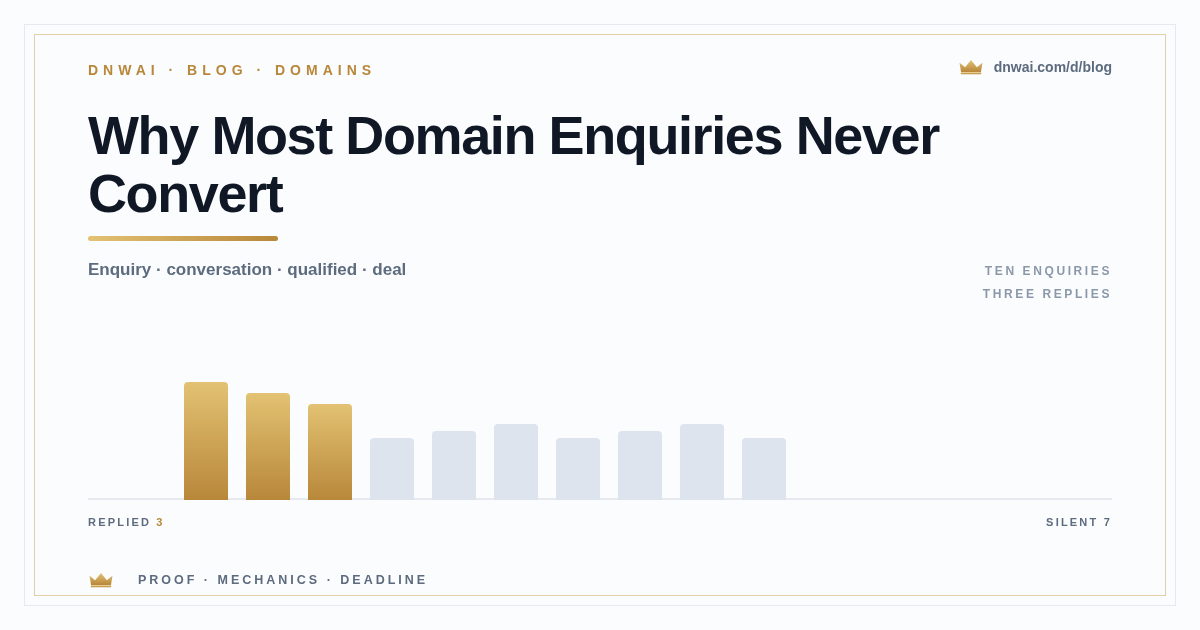
Why Most Domain Enquiries Never Convert
Every portfolio owner knows the same small joy: a form submission arrives, the name you have stared at for eight months finally has somebody interested. Then a week passes. Nothing. You look at the listing again, wonder whether the BIN was too high, and quietly cut the price. Three weeks later the same silence.
The hard part is not finding the enquiry. The hard part is that an enquiry is not a decision, and the gap between the two is where almost all the money goes missing. This is about that gap: the sequence of messages that closes it, the proof that shortens it, and the deadline that ends it one way or the other.
What an enquiry actually is
A form submission tells you three things and none of them is a budget: the person knows your name, they took thirty seconds to think about it, and they left a way to reach them. That is it. No number, no urgency, no authority to buy.
We track four states now, and we refuse to blur them:
- Enquiry — a form submission, a marketplace message, an email. Counted, never celebrated.
- Conversation — the other side has replied at least once to a specific question. This is the first real signal, because typing takes far more commitment than clicking submit.
- Qualified — a number has been named by them, a budget or an authority is visible, and there is a timeline.
- Deal — price agreed, escrow opened, payment instruction sent.
The leak happens between one and two. Most enquiries die there, and they die silently — not because the price was wrong, but because the reply didn't give the person a reason to write back.
The three-copy fallback
Every enquiry that gets no reply for seventy-two hours gets a second one. That is the only follow-up rule in our own process that has ever mattered, because a good share of replies arrive after the second touch, from people who were interested all along and simply got busy.
The second message is not a reminder. It is the offer, restated, with the three things the first message usually forgot: the artefact, the mechanical path, and the clock.
The artefact
A screenshot-free buyer asks themselves the same question: is this a real name attached to a real person? Answer it before they ask. The reply carries one link — the public listing or portfolio page — so the price is verifiable without a login, and nothing else. No attachments, no ZIP, no five-paragraph history of the registration.
The mechanical path
"Would you be open to selling?" is a question that demands research. "The BIN is $X, transfer goes through escrow, funds release when the name is in your account, and the name moves the same day" is a decision that only needs a yes or a no. Describe the mechanics precisely enough that the buyer can answer with one word, and they usually will.
The clock
A deadline is not a discount. It is a decision device, and it is the single most effective thing you can add to a stalled thread, provided you are actually willing to honour it:
- A listing that expires on a real date, because the renewal is coming and you will not carry it another year at no traffic and no reply.
- A price that holds until the end of the month, then returns to the listed figure. If the buyer is comparing three names this week, the comparison now has a time dimension.
What a deadline must never be is fake. "Offer valid 24 hours" on 365 days a year is the domain equivalent of a permanently closing-down sale, and buyers in this market read a lot of those.
The twenty-minute proof pack
The reason so many enquiries stall is not price. It is that the buyer has to build a business case from nothing, and they do it at their kitchen table after work. Anything you can do to shorten that homework moves you from a maybe to a decision.
We keep a small proof pack per enquiry-worthy name, assembled in about twenty minutes:
- Three search-result screenshots. The name, the phrase, and the two obvious variants — what a person looking for this would type into a search bar, not what an appraisal tool says about the string.
- Two comparable sales. Not a headline auction result; something in the buyer's own price band and their own vertical, with a date and a marketplace attached. Two is enough. Five looks like you are arguing.
- One sentence of substitute cost. What the buyer will spend in time and half-decent alternatives to find something they like as much.
The pack is not sent to everyone. It is offered: "I can send the comparison and the market notes if it helps." The offer itself is a filter. Nobody who replies "yes please" to that is a tyre-kicker.
Discounting is the wrong lever
When a thread goes quiet, the instinct is to move the number. We have done it, and it is usually the worst available move, for a specific reason: a discount converts an objection about value into a confession that the original number was invented. The buyer's real objection — timing, budget approval, an alternative they were considering — is never addressed by taking $200 off, and once the price moves, every price moves. A buyer who learns that your first number was soft will test the second one too.
What works instead is narrowing: hold the price and reduce the scope of the decision. Split the payment into an AtomPay-style instalment path where that is available to the buyer, offer a shorter escrow path, or offer to include the landing page you already built. You have made the yes cheaper without making the name cheaper.
There is one case where cutting the price is correct: when the deadline arrives with no answer and the name genuinely costs you money every month it sits. But that is not discounting as negotiation. That is exiting a position, and it should be logged as such.
The numbers nobody counts
Every domainer can quote an appraisal value. Almost nobody can quote their own conversion funnel, because it requires counting the embarrassing stages.
We started this year with a simple tally — enquiries in, replies out, prices named, deals closed — and the first surprise was the shape of it. The enquiries arrive in clusters, not evenly. They cluster after a listing change, after a price drop, and in the days following any outbound batch. That means the denominator is not "days" but "changes we made", which changes the strategy: if enquiries follow activity, then activity is the cheapest marketing channel available, and inactivity is the most expensive.
The second surprise was how many conversations were killed by our own reply speed. A buyer with budget in hand is shopping; thirty-six hours of silence is long enough for them to find a fourth option. We now work to a same-day rule for anything that arrives with a question in it. It costs ten minutes and it changes the reply rate more than any title rewrite we have ever done.
The third surprise was that the price named was usually the price paid. When we started naming a clear number early, instead of inviting offers and negotiating down from an invisible ceiling, the deals closed faster and not always lower. A buyer who knows the number can decide; a buyer invited to guess has to be motivated enough to guess.
A worked example that did not close
We keep one open case in the notes precisely because it did not close. A name in our portfolio sat at $1,795 with an AI appraisal of $1,199 sitting right there in the listing. Two enquiries came in on the same name within a month. Both asked the same question in different words: "why is your price above the appraisal?"
Neither was a lowball. They were doing the obvious homework, and the listing had answered the question for them in the worst possible way — by putting a lower number next to a higher number with no explanation. Both threads ended in silence. Nothing had been asked of us and nothing had been refused.
The lesson is uncomfortable and cheap: a listing has to answer the buyer's first objection before they voice it. That means the price needs a reason attached — the comparable, the traffic, the brand's use — and the appraisal is not a secret to be hidden, but a number to be addressed.
What we now do instead of waiting
Four habits, all of them cheap:
- Reply same day with the mechanics. Price, escrow path, transfer timeline. One link, no attachments.
- Ask one specific question. "Is this for a product you are launching or for a client?" It costs nothing and it tells you which of the four states you are in.
- Offer the proof pack. Twenty minutes of homework removed from the buyer's evening.
- Set a real clock, then honour it. No third touch after silence. The deadline is the third message.
The point of all of this is not to chase more enquiries. It is to stop treating an enquiry as a result. A reply is a result. A number named is a result. Everything before that is just a door being opened, and most doors are closed again by nobody in particular, simply because no one put a hand on them.
It is also worth saying plainly: not every quiet enquiry is a lost deal. Some are people writing to five sellers at once, and the silence has nothing to do with you. But you cannot tell the difference from the outside, and the cheap assumption — that the next touch decides it — costs one email. The expensive assumption, that silence means the price was wrong, costs the price itself.
Buying a name this week?
180 exact-match, brandable and geo domains — buy-now price, escrow-protected, same-day transfer. See the portfolio · the contact page
Buying a name this week?
180 exact-match, brandable and geo domains — buy-now price, escrow-protected, same-day transfer. See the portfolio · the contact page