
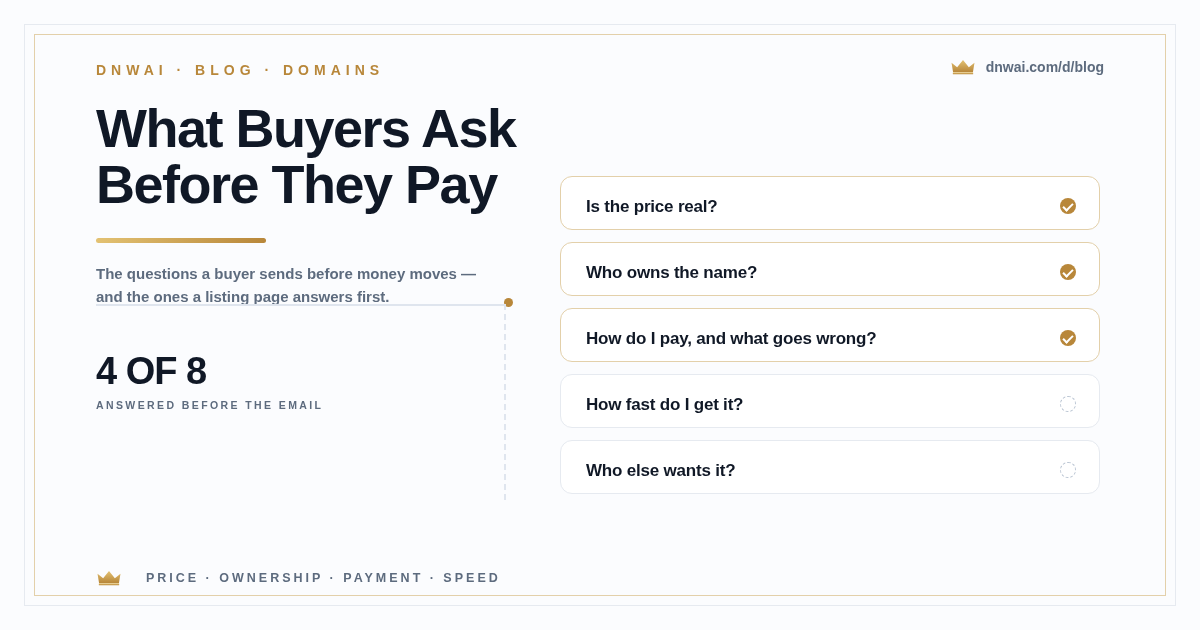
What Buyers Ask Before They Pay
A buyer who is ready to pay rarely opens with an offer. They open with a question, and the question is a test. Across 2,097 sent emails and every thread that came back, the same eight questions appear in roughly the same order. Answer them before they are asked and the deal moves; answer them badly and the thread dies quietly — the most expensive outcome in this business. What follows is not a script but a map: what each question tests, and what a listing page should settle before the first email is typed.
The data behind this, stated plainly
Our sending records cover 112 campaigns, 3,932 prospects, 2,097 emails sent, 14 marked as replied. Most of the 14 are not buying questions: out-of-office notices, auto-responders, a platform saying it does not represent the properties we asked about, two people asking us to stop. The four that matter:
- "I can offer you 50$ if you like." — a number, on a name listed at $375.
- "Stoo" — one word, from a buyer whose previous thread had reached a real number.
- "I'm not interested." — after we sent the price.
- "I'm good please stop." — after a follow-up.
None of those is a refusal of the name. Three refuse the process: the price arrived too early, the follow-up arrived too often, or the number was so far from the ask that we looked unserious.
The shelf behind this: 191 priced names, $232,757 total asking, a median ask of $1,120, a floor of $120, a ceiling of $4,710 — 139 .com, 45 .si. Every listing page carries four lines: the buy-now price, "Reasonable offers considered", "Instant push, same day", "Escrow / marketplace checkout". Not decoration — the first four answers below.
Question one: is the price real?
Not a defence of the number — a check that it exists, that it is yours to change, and that it is identical everywhere it appears. One price on your site, another on two marketplaces and a third in an email teaches a buyer that the price is a mood.
A good answer: a single buy-now viewable without a login, marketplaces linked from the same page, one sentence on what offers are considered. "Buy-now price. Reasonable offers considered" gives the buyer both halves: a firm number and a door. If the email quotes lower than the page, the page stops mattering, and so does every future email.
The failure mode is the "final notice" email: ours read "this is my last note on the name, I will be listing it publicly this week" and drew a $50 offer on a $375 name. A deadline with no change in price teaches that the number is fictional and the floor is wherever the buyer says it is.
Question two: who actually owns this, and is the name tied up?
A buyer burned once asks whether the name sits at a registrar you control, whether it is locked, and whether anything points at it — an exclusivity, a reseller agreement, a pending transfer. The honest answer is short: registered, credentials held, transferable by push or auth code, not locked behind anyone else's promotion. If it is listed under a tier that demands nameservers pointed at a marketplace, say so, because the buyer will see it in a WHOIS lookup and the discovery costs you the thread.
It also covers the trademark screen: a buyer about to build a brand is asking whether the string is safe to use. "No operating company in this class uses the exact string" is worth more than any appraisal number, and it takes twenty minutes to be able to write.
Question three: how do I pay, and what am I paying?
Buyers pay through marketplace checkout, escrow, direct transfer or a payment plan, and have opinions about all four. Each carries a cost that is not the price.
Escrow.com's published domain fee is 2.6% with a $50 minimum up to $5,000. On a $488 name that is $50, over 10% of the sale — which is why small deals skip third-party escrow, and why the question on a $488 name is really whether the paperwork is worth it. On a $2,800 name the same fee is $72.80. Marketplace checkout folds its commission into the visible price, which is why two listings of one name can look like different deals.
A complete answer names the route, says who pays which fee and gives the sequence: "marketplace escrow, you pay the listed price, funds release when the name is in your account, same-day push." Anything vaguer invites the buyer to assume they pay first and hope.
Question four: how fast do I actually get it?
Speed sounds like impatience and is really about risk; a buyer with a launch date is buying time as much as a name. Two mechanics decide the answer:
- Push versus transfer. A name at the buyer's registrar moves in minutes; a cross-registrar transfer takes up to five days for the standard wait, longer if the losing registrar is slow.
- The 60-day rule. A name registered or transferred within 60 days may not transfer again without the current registrar's help — a seller who does not know this promises five days and delivers two weeks.
Our listing pages say "Instant push, same day", which is true for names we hold at registrars our buyers use, and only usually true otherwise. The honest answer is conditional and specific: same day on a push, up to five business days on an auth-code transfer, and here is what decides which one applies to you.
Question five: what happens if something goes wrong?
Buyers ask this least often and care about it most. It covers three things: what if the name does not transfer, what if the seller disappears, what if the name arrives with a history they did not expect.
The answer is the escrow model in one sentence: money to a neutral party, name to your account, money released after you confirm, refund if the transfer fails. A buyer who understands that negotiates less defensively.
The history part is worth volunteering: a name that carried a business can carry links, reputation and an archive. "No live site, no active links we track", said before the buyer finds an old snapshot, is the difference between a careful buyer and a suspicious one.
Question six: who else wants it, and what is the real floor?
What they test here is not scarcity but whether the price is anchored to anything beyond the seller's hope. Two honest anchors exist: comparables in the same extension and category, and the make-offer floor if the marketplace publishes one. On our own shelf, the make-offer floor was set at a median 61% of the buy-now, which means a buyer asking about a $1,120 name is, in practice, negotiating toward roughly $680. "Make me an offer" invites a number below the floor; "offers under $680 are declined" removes a round of theatre.
What we never do is invent competition. An unverifiable "two other buyers" story is the fastest way to turn a careful buyer into a silent one.
Question seven: what does it cost me every year?
This separates a hobbyist from a professional buyer, and sellers forget it most. A domain is a subscription with a purchase price: on a .com at $12–22 a year, ten years of ownership costs more than many names on a small portfolio, and a .si renews in the same rough band. A buyer paying $1,120 for our median name is buying an asset plus a bill that never ends until they sell or drop it. State the renewal class plainly, and mention any transfer requirement. A seller who hides a premium renewal to close a small sale has sold a name that will be dropped in year two, and the buyer will remember who sold it to them.
Question eight: can I talk to a person?
Anyone reaching question eight has decided the price is plausible and is checking whether the seller is real: a name, a signature, a page, a same-day reply.
Our record here is the weakest part of the story: 14 replies across 3,932 prospects is not a conversion engine but four test cases, three of which failed on process rather than price. The fix was not a better email — it was publishing the answers on the page the email links to, so the first reply can be a number instead of a question.
What the four real replies say
The replies line up against the eight questions almost too neatly:
- The $50 offer on a $375 name came from a campaign whose email announced an imminent public listing: price credibility was the question, and a $50 bid asks how low you will go before admitting the number is arbitrary.
- "Stoo" came in a thread where we had already moved the price once. The buyer tested whether the price was real, concluded it was not, and stopped writing sentences.
- "I'm not interested" followed a message that led with price and nothing else: no ownership, no payment route, no transfer time.
- "I'm good please stop" followed a follow-up. The first message asked nothing, so the second had nothing to continue.
In all four, the missing ingredient was never the price — it was the answers a buyer needs in order to decide instead of reply.
The page that answers before the email
The practical output is a page structure anyone can copy:
- The number, stated once, with the word buy-now attached to it.
- What an offer means: considered, declined below a floor, or not accepted at all.
- Ownership and transfer mechanics, in one sentence each.
- The payment route and who pays which fee.
- The speed, with the conditional that makes it true.
- The renewal class, so the annual cost is not a surprise.
- The trademark note, if the screen has been run.
- A contact route that a human answers.
Each removes a question that would otherwise cost a round trip — and the round trip is where the deal dies.
The uncomfortable conclusion: the email was never the bottleneck. 2,097 sends produced 14 replies — mostly noise, three process failures. The names that sell are the ones whose pages answer these eight questions before anyone types a subject line — a buyer who has to ask is a buyer who has to be convinced, and a buyer who has already been answered only has to decide.
Buying a name this week?
191 exact-match, brandable and geo domains — buy-now price, escrow-protected, same-day transfer. See the portfolio · the contact page
Buying a name this week?
191 exact-match, brandable and geo domains — buy-now price, escrow-protected, same-day transfer. See the portfolio · the contact page