
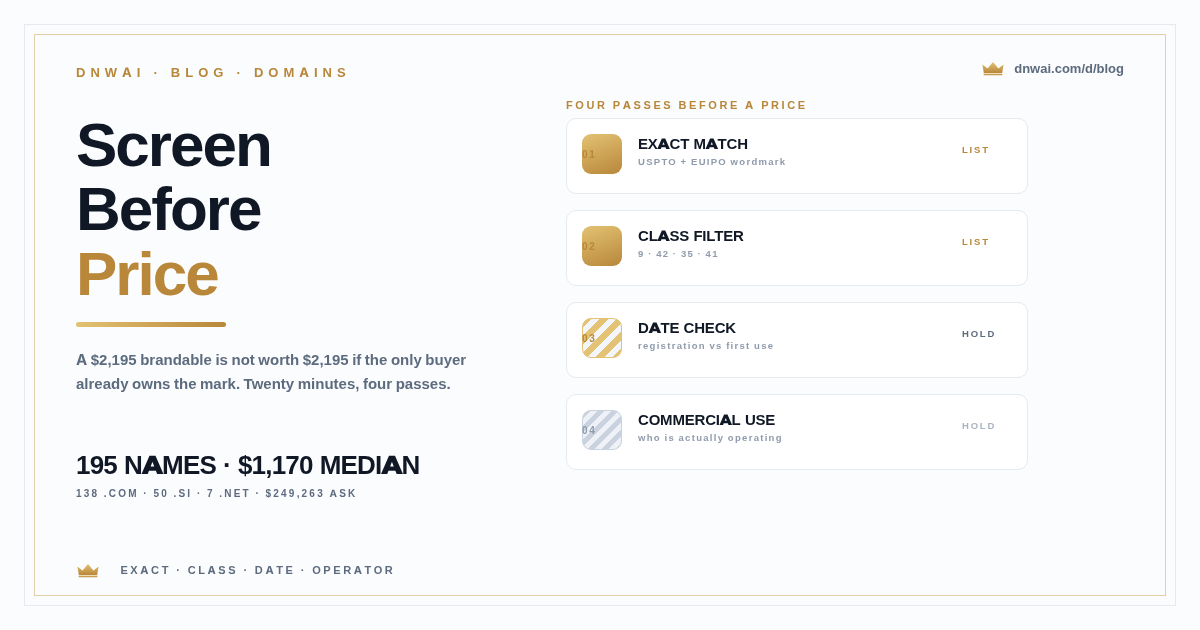
Trademark Screening Before You List: The 20-Minute Check
Every portfolio post on this blog argues about numbers, and every one of those numbers assumes the name is clean enough to sell. A $2,195 brandable is not worth $2,195 if the only serious buyer in its category already owns a registered mark on the word and has a lawyer who files complaints on retainer. That is not a pricing problem. It is a filtering problem, and it belongs at the front of the pipeline, not the back.
I learned this the ordinary way: by almost listing a name that I had no business selling. Nothing dramatic happened. I searched the word, found a live registration in the same class a buyer would operate in, and pulled the listing before it went up. The 20 minutes that search cost saved a week of drafting and a much worse conversation later.
This post is the check I run now, on every candidate, before a name is listed at any price. It uses the live shelf for scale rather than for decoration: 195 names, 138 .com, 50 .si and 7 .net, a total ask of $249,263, a median of $1,170 and a range from $120 to $5,300. Those figures come from the listing page itself. The point is that a shelf this size gets screened in batches, not one name at a time over a coffee.
What a trademark actually protects, and what it does not
The first correction is conceptual. A trademark does not protect a word. It protects the use of a word as a source identifier for particular goods or services, within a jurisdiction, and generally within a class of goods or services. That distinction is the whole game for domainers.
"Apple" is a computer company and a fruit. Someone selling fruit under a different name is not infringing Apple's mark in the computing class. The same logic means a name can be perfectly saleable in one category and radioactive in another — and since a domain's value depends entirely on who wants to buy it, the category is what you screen, not the string in isolation.
Two further pieces matter just as much:
- Unregistered rights exist. In many jurisdictions, including the US under common-law principles, a business that has used a name in commerce can hold rights without ever filing. There is no database for those rights, which is exactly why the search never ends at the register.
- Registration is not required for a UDRP complaint. WIPO's own guidance is that any owner of a registered or adequately pled unregistered mark can file against a domain. A letter from a well-funded company costs nothing to send and a great deal to answer.
So the question is never "is this word trademarked?" It is "could a specific company, in the category a buyer of this name would operate in, argue that my listing of this word is a problem?"
The 20-minute check, in four passes
I run four passes, in this order, and I stop at the first one that produces a hard stop. The timing is real: a clean name takes under ten minutes, a name with questions takes longer.
Pass 1 — Exact match in the two registers that matter (5 minutes)
The USPTO retired its long-standing TESS search interface at the end of November 2023 and replaced it with a cloud-based search system. Anyone using a tutorial older than that is following instructions for a tool that no longer exists. The current system supports exact wordmark search, field-tag searching and phonetic or alternate-spelling searches using regular expressions — which is precisely what you want for a brandable.
For EU-facing names, add the EUIPO database. Two passes over two registers covers the overwhelming majority of the buyers a four-figure domain actually reaches. Search the word itself, then the word minus any suffix a buyer might attach.
What I record for each hit: the mark text, the status (live, dead, abandoned application), the class, the owner, and the filing date. Filing date is the one I care about most, because of the next pass.
Pass 2 — The class filter, which is where most "hits" die (5 minutes)
Class 9 covers software and downloadable goods; class 42 covers software as a service and technology services; class 35 covers advertising and business services; class 41 covers education and entertainment. A name held in class 25 for clothing is not a stop for a name being sold to a SaaS founder, though it is a caution if the buyer might ever sell merch.
Pass 3 — The date problem (3 minutes)
If my registration of the domain predates the trademark owner's first use, the position is much stronger than if it came after. WIPO's overview of panel views is explicit that where a respondent registered the domain before the complainant's rights accrued, panels will not normally find bad faith. It also notes narrow exceptions — a name registered shortly after a merger announcement, or after a launch with significant media attention, is treated differently.
Pass 4 — The commercial reality search (5 minutes)
Registers do not know about a company that trades under a name it never filed. So the last pass is a browser: the name in quotes, the name plus "pricing", the name plus the category. What I am looking for is a real business operating under that word with visible commercial activity — a site, a pricing page, a storefront, a LinkedIn company page with employees.
What the 195 names on the shelf look like after screening
Here is what a portfolio actually looks like when you screen it. Of the 195 names live today, the distribution matters more than any individual case. Fifty-five ask under $500, 27 sit between $500 and $999, 82 sit between $1,000 and $1,999, and 31 ask $2,000 or more.
The median .com on the shelf is $940 and the median .si is $1,999. That asymmetry is not an accident of pricing taste. It reflects what the categories are: the .com side carries many descriptive phrases — a repair service plus a city, a job title plus a place, a function plus a noun — while the .si side carries more coined and exact-match brandables, which are exactly the names most likely to collide with a live mark.
Two structural properties of this shelf are worth naming because they are the result of the screening, not a coincidence:
- No name on the shelf contains a hyphen. Hyphenated names are the single most common shape of a domain registered around someone else's mark, and they are also bad brandable inventory. Two arguments, one rule.
- No name on the shelf contains a digit. Same reasoning: digits are how you sell the "cheap version" of an existing brand, and the market for that version is a defendant's docket.
Descriptive phrases (a service plus a location) are the low-risk end of the shelf and the low-price end too. Coined brandables are the opposite: they carry the top of the price range, and they are where the screening has to be most careful. A $4,999 name and a $450 name are not screened with the same intensity, and pretending otherwise is how a portfolio takes on risk it never priced.
The three outcomes, and what each one costs
Every name lands in one of three buckets. Naming them explicitly stops the endless re-litigating that happens when screening is done by feel.
- Clear. No live mark in a relevant class, no visible operator in the category, registration date comfortable. List it, price it normally.
- Crowded. Marks exist but the classes are unrelated, or the word is used broadly as a category term. List it, but describe the name as what it is and avoid implying an association with any existing business. Do not write listing copy that borrows a known brand's positioning.
- Blocked. A live mark in a class the buyer would operate in, or a visible operator with a launched product. Do not list. Do not email. The name stays in the renewal decision, and the renewal decision is where it should have been all along.
The cost of a wrong listing is not the loss of a sale. It is the complaint. Under the UDRP, a complainant must show three things: rights in a mark, that the registrant has no legitimate interest, and that the name was registered and is being used in bad faith. None of that is automatically fatal — but it is a proceeding with a deadline, a filing cost, and a decision published under your name. That is a very expensive way to learn that a $1,170 listing should have been a $0 renewal you let go.
What I do in the last ten minutes before a listing goes up
The check is only useful if it leaves a record. Mine is a short line per name in the same sheet that holds the price — four fields, not an essay:
- Search date and which registers were checked.
- Closest hit: mark text, class, owner, status.
- Registration date of the domain, next to the mark's first-use date.
- Bucket: clear, crowded or blocked, with a one-line reason.
That record makes the decision auditable a year later when the price is reconsidered, produces the fact you want if a letter ever arrives, and lets twenty names be screened in one sitting — which is the only way screening survives a shelf of 195.
The uncomfortable part
Screening is not a legal opinion and I do not present it as one. What it is, is a filter that costs twenty minutes and removes the handful of names capable of turning a routine four-figure sale into an argument. On a portfolio this size, that filter runs maybe six or seven times a year and each run protects weeks of work.
The uncomfortable part is the names it takes away. Some of them are the best-sounding names in the batch, and the temptation is to list them anyway, label them "brandable" in the description and hope the buyer's category is narrow enough. That works until it does not — and the failure mode is not a lost sale, it is a name you cannot renew in good conscience and cannot sell at any price, sitting in the ledger as a reminder that you skipped the first pass.
The discipline that actually compounds is boring: screen first, price second, list third. The 195 names on this shelf are the ones that survived the first step. The prices attached to them mean something precisely because that step already happened.
Buying a name this week?
193 exact-match, brandable and geo domains — buy-now price, escrow-protected, same-day transfer. See the portfolio · the contact page