
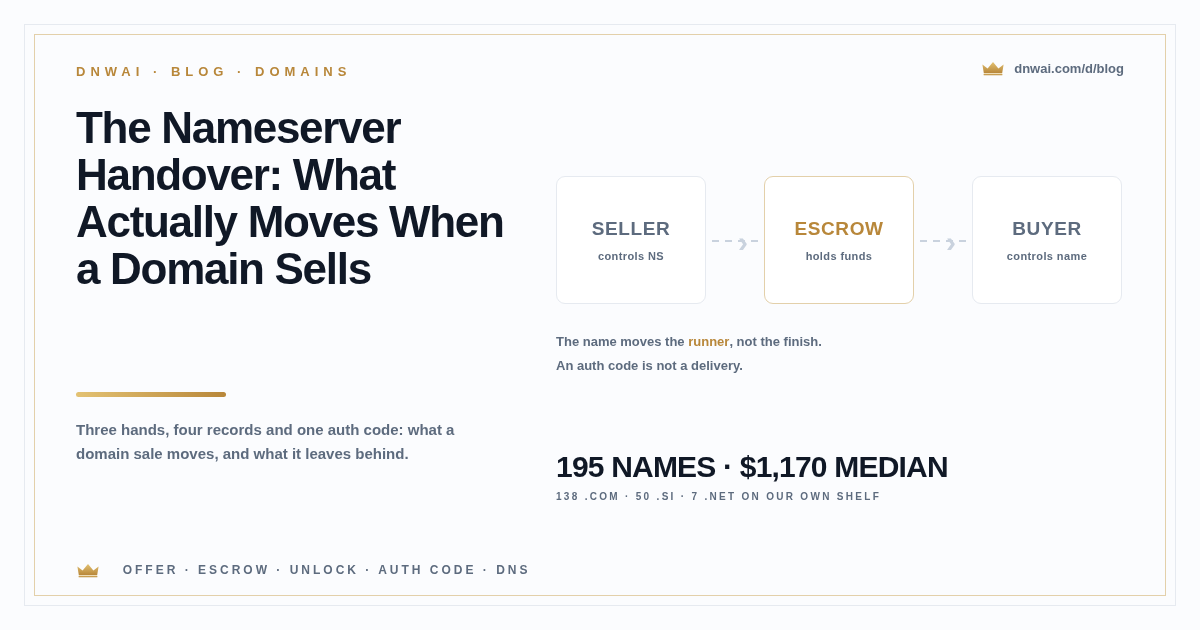
The Nameserver Handover: What Actually Moves When a Domain Sells
Every domain sale has a moment that decides whether the deal survives: not the price, not the escrow, but the nameserver handover. The buyer has paid, the seller has signed, and then two sets of nameservers discover they were never introduced. I have watched a funded sale sit for eleven days because a single NS record pointed at a parking service the seller had cancelled months earlier, and I have watched a cheaper name close in twenty minutes because both sides had agreed in writing what "handover" meant before the first dollar moved.
This article is about the plumbing. It is the part of a domain sale nobody negotiates and everybody loses time on, and after enough transfers the failure patterns become predictable enough to write down. All numbers below come from our own published shelf — 195 names on dnwai.com/d as of today, 138 .com, 50 .si and 7 .net, with a $1,170 median ask — and from the transfer rules the registrars themselves publish. Nothing here is a forecast.
Three owners, four records
A domain does not move from seller to buyer. It moves from seller to intermediary to buyer, and each of those hands owns a different layer of the same name:
- The registry layer — the authoritative name servers, held at the extension's registry and set by whichever registrar controls the name.
- The registrar layer — the account that can change those name servers, unlock the transfer, and hand out the auth code.
- The content layer — the A record, the MX records, the TXT records that prove ownership to third parties.
- The past layer — the TTL cached on thousands of resolvers around the world from whatever the name was doing last month.
The seller controls the runner. The buyer controls the finish. The middle is where deals go wrong, and the reason is simple: a sale transfers the runner, not the finish. A buyer who pays for a name whose nameservers still point at the seller's parking page has bought a domain that resolves nowhere near what he expected to buy.
What escrow actually moves
Escrow does not move a domain. It moves money and it holds a commitment. The name is transferred by you and by the buyer's registrar working on the name's own DNS, and escrow only confirms that both sides did what they promised. That distinction explains the thing sellers find most frustrating about escrow: the money can be sitting in full and the name can be nowhere near working.
The practical consequence is that the handover has to be specified in the message where you accept the offer, not in the message where the money clears. When we accept an offer, the reply states four things:
- The name will be delivered the same day the escrow marks funds as confirmed.
- The name servers will be changed to the buyer's or the marketplace's named servers before the auth code is issued.
- The name is unlocked and the auth code is valid for the registry's standard window.
- The buyer's account will hold the name, and any auxiliary records he wants will be set by us from a written list, once, before the transfer.
That third point is where sellers lose the most time. Auth codes expire, and an expired code during a sixty-day transfer lock is a stale promise that has to be renegotiated. We issue the code the same hour the transfer begins and never before the buyer confirms he is ready to use it.
The marketplace case: where the NS is not yours
When a name sells through a marketplace rather than directly, the nameserver question gets stranger, because the marketplace is often the intermediary twice: once as the venue holding the buyer's money, and once as the registrar-of-record where the name might be parked for delivery.
Two of our own listings on dnwai.com/d demonstrate both states. A .si name at $4,999 and a .com at $195 sit in the same list and are governed by completely different handover logic. The .si name can only be transferred inside the registry's own ecosystem; the .com can travel between registrars with an auth code and a sixty-day lock. If a campaign message to a prospect treats both as "a domain for sale, same process," the buyer discovers the difference at the worst possible moment: after he has budget approval.
There is a second layer of trouble in marketplace sales: exclusivity. Some venues ask for the name servers as a condition of a premium or featured placement. Once the nameservers point at the venue, the name is not deliverable anywhere else without moving them back, and moving them back during a pending sale is exactly the kind of change that stalls a transfer. A seller who accepted a premium listing condition on Monday and a direct offer on Wednesday owns a conflict he cannot resolve by email.
The rule we run is simple and has cost us listings: nameservers stay under our control until an offer is accepted in writing, and exclusivity terms get read before a listing is published, not after a buyer appears.
The four handover mistakes that lose a sale
The stale auth code. The seller generates the code, sends it, and then goes quiet. The buyer's registrar rejects it on day two. Most registries issue codes with a short life; the failure looks like a buyer problem and is not. The fix is to issue on request and reissue on demand without argument.
The unlock that never happened. The registrar panel shows a lock icon the seller has never touched. Transfers silently refuse, and the buyer reads silence as a seller stalling. The fix is a screenshot of the unlocked state in the same message as the code.
The DNS that follows the money. The name transfers, and the DNS records transfer with it because nobody cleared them. The buyer's new site goes live pointing at the seller's email server, which then starts rejecting mail for a domain it no longer owns. This is the most expensive of the four because it produces a broken inbox the buyer discovers from a customer, not from you.
The waiting period nobody counted. After a registrar-to-registrar transfer, the name is locked to the new registrar for a period the registry sets. A buyer who plans to move the name again in the name of "cleaning up" finds he cannot, and the timeline he gave his board evaporates. This is not a seller error, but it becomes a seller problem when nobody mentioned it.
What I now put in writing before any transfer
Four lines, sent in the same thread as the accepted offer, have removed almost all of the friction:
- Current registrar and the registry extension.
- Whether the name is locked, and who unlocks it.
- Current nameservers, and what they will be changed to before delivery.
- What happens to MX and TXT records, stated as an explicit choice between "cleared" and "replicated."
That last line matters more than it sounds. A name that carries a live business email must not have its MX cleared mid-transfer, and a name that carries nothing should not arrive with the previous owner's verification TXT records still published. Both errors are cheap to prevent and expensive to explain.
Reading the shelf's own handover risk
On our own shelf the distribution tells a handover story. The 50 .si names carry a median ask of $1,999 and the 138 .com names a median of $940, and the two groups have almost nothing in common in transfer mechanics. Only six of the 195 names sit at $300 or below, which means the overwhelming majority of the shelf will sell at a price where a stalled transfer costs more than the escrow fee. At that level, the paperwork is not overhead — it is part of the product.
The cheapest names on the shelf are the ones where I expect the least friction, and that is the opposite of what most sellers assume. A $195 .com changes hands with a code and an unlock and is done. A $4,999 .si needs a plan, a timeline, and a paragraph the buyer can forward to his own IT person.
The rule I would give a first-time seller
Before the offer is accepted, write the number of days you are willing to spend on the handover. Then design the delivery so it fits inside that number. Everything else in this article is detail; the sentence is the discipline. A sale that closes at 95% of your ask but takes three weeks of your attention is often worse than a sale at 80% that finishes in a day, because attention is the only inventory a small portfolio actually runs short of.
The handover is not a technicality after the sale. It is the last negotiation of the sale, and it is the only one you can win before it starts.
Buying a name this week?
193 exact-match, brandable and geo domains — buy-now price, escrow-protected, same-day transfer. See the portfolio · the contact page