
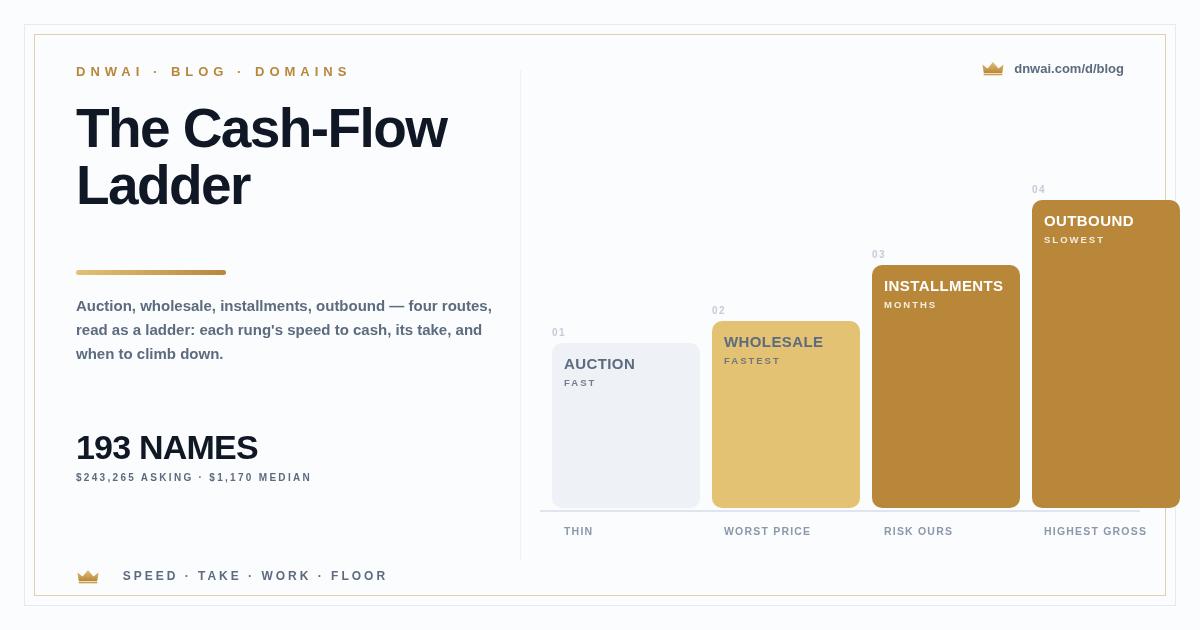
The Cash-Flow Ladder: Auction, Wholesale, AtomPay, Outbound
Four routes will sell a domain: an auction, a wholesale board, an installment checkout, and a cold email. They are usually described as alternatives — as if you pick one and commit. They are better read as a ladder. Each rung has a different speed to cash, a different take rate, and a different amount of work you do yourself. Most portfolios lose money not because the names are bad but because the owner climbs the ladder in the wrong order, or refuses to climb at all, sitting on a name that has been "about to sell" for eleven months.
The four rungs, defined by what they cost you
Before any pricing talk: what does each route charge in time and money?
Auction. You list, set a reserve or don't, and bidders arrive or don't. The marketplace takes its percentage at settlement; the clock does the selling. Fast to set up, variable in outcome, and the only rung where a name can sell for less than you wanted without you agreeing to a number in an email.
Wholesale board. Price low, post to a room full of resellers. The take rate is typically zero because you are selling to the trade at trade prices. Conversion is quick — resellers read prices for a living — and the price is the worst of the four. That is the point of the rung.
Installment checkout. The name stays listed at retail and the buyer pays in parts. The gross is retail, the cash arrives over months, the default risk is yours unless a marketplace holds the money. This is a financing product, not a channel: it converts buyers who cannot pay today into buyers who pay by spring.
Outbound. Find the person who needs the exact word, and write to them. Highest gross, slowest, least certain, and the only rung where the work is entirely yours.
Auction and wholesale convert fastest and pay least. Outbound pays most and converts slowest. Installments sit between them, trading time for price.
The shelf we are working from
Numbers first, because a ladder with no rungs counted is a metaphor. The live portfolio page today lists 193 names — 138 .com, 48 .si, 7 .net — with $243,265 in total asking, a median ask of $1,170, a floor of $120 and a ceiling of $5,300. The cheapest name on the shelf is a .net at the floor price; the most expensive is a .si.
Two facts about that shape matter. A median of $1,170 means half the shelf sits below the level at which outbound makes economic sense: writing a personalised email to sell a $300 name is a hobby with an invoice. And the tail above $2,000 is small — only those names carry an auction reserve, an installment plan and a written campaign at the same time.
So the ladder is worked per tier, not per portfolio. The bottom goes wholesale or stays cheap on the shelf, the middle gets auctioned and offered installments, the top gets outbound. Doing it the other way round — a month of emails on $200 names while the $4,000 names sit untouched — is the most common form of overwork in this business.
Rung one: the auction, and the reserve decision
The auction's job is to establish whether a name has public demand at all: a measurement instrument that occasionally pays you. Two numbers decide the outcome — the reserve and the starting bid. A reserve above what a room will pay produces cards that close unsold and a seller who concludes the name is worthless, when the room was simply never shown a price it could enter at.
The worked example: a name you would accept $900 for. No reserve at $99 and it may close at $240 — a loss against your floor, but a sale and a data point. A $900 reserve and it may close unsold: no loss, no cash, the same uncertainty. A $450 opening with no reserve usually closes between $450 and $800 — a compromise you can live with, at a price the market proved.
Our rule: no reserve only when the opening price is already one we would sign for; a reserve at 60 to 70 percent of the retail ask when we want the measurement, not the sale. Never a reserve at retail — that is not an auction, it is a listing with an audience.
The cost side is the settlement commission plus the renewal you pay anyway. A $1,000 close with a 15 percent take nets $850. The same name wholesale at $400 nets $400. The same name on an installment plan at $1,170 over six months nets $1,170 minus payment fees — in pieces, with default risk.
Rung two: wholesale, for names you have stopped believing in
Wholesale is not for names you love. It is for names you have decided not to spend another renewal on, or whose renewal cost exceeds their plausible upside.
The arithmetic is simple: a name renewing at $12 with a realistic retail price of $190 has a 15-year payback at full retail. If it does not sell in a year, wholesale at $60 is not a defeat: a $48 net gain and one fewer renewal.
The trap is using wholesale as a discount channel for names that would have sold at retail. Decide the tier before you post, not after.
Rung three: installments as a conversion tool
A buyer who wants the name and cannot pay $2,400 today is not a bad lead — they have a cash-flow problem, and a payment plan solves those. This is the rung most portfolios skip, and the one that converts the most "we'll revisit next quarter" threads into contracts.
The mechanics that matter: price stays at retail, the term is short by design (three to twelve months), the first payment is large enough that the buyer has skin in the game, and the name does not transfer until the final payment unless a marketplace's escrow holds it. That last clause is the whole risk model. Seller-financed installments without escrow are an unsecured loan to a stranger who happens to want a word you own.
A $2,400 name at 25 percent down is $600 now and $300 a month for six months. If the buyer defaults at month four you have collected $1,500 and kept the name — excellent or a legal problem, depending on what your agreement says. Write the agreement first; platforms that hold the funds solve this and charge for it, usually less than the dispute costs.
Rung four: outbound, only for the top of the shelf
Outbound is the highest-margin rung and the one people abuse. The economics only close if the price is a multiple of the cost of finding and writing to a shortlist.
The cost per real conversation is not the cost per email. Our own records this year: thousands of emails across more than a hundred campaigns, and the threads that became human negotiations can be counted on one hand. That is not a reason to abandon outbound — one close at the top of the shelf pays for an enormous amount of silence — but it is a reason to reserve it for names where a single close changes the month.
Which names qualify: an obvious single buyer, a price above the point where your hourly rate is respected, and a personalised email that can say something true about that buyer's business. If the best sentence you can write is "I noticed you might be interested in this domain", you are doing bulk mail with extra steps.
Cadence matters as much as targeting: four touches, price at the third, a discount only at the fourth, and a human reply stops everything. Faster trains people to ignore you; slower never reaches a busy person.
When to move down a rung
The rule for moving down is time-based, not mood-based. A name that had an outbound campaign and no reply in sixty days moves to auction. A name that had an auction with a reserve and no bids moves to wholesale at your floor. A name that fails wholesale gets dropped, not renewed again.
The reverse move — from wholesale back up to retail — almost never happens in practice, which is why the decision to go down should be made with the renewal date in view rather than in frustration after a bad week.
The worked ladder, using the shelf's own numbers. A $1,170 median name: outbound for sixty days, no reply; auctioned at a $700 reserve, closes at $820; net after a 15 percent take is $697. Had it been wholesaled immediately it might have netted $350. The ladder is an order of operations that stops you paying retail prices in time and wholesale prices in money.
What it fixes is the most expensive habit on the shelf: treating every name as a candidate for the highest-paying route, forever. A 193-name portfolio cannot carry 193 outbound campaigns. It can carry a handful of auctions, a wholesale list and an installment option — and the discipline is deciding which name is which on paper, before the renewal date decides. And if the retail ask is twice what the market will bear, no rung fixes it: each one just converts that truth into a different shape of failure.
Everything else on the shelf is a timing decision, and timing is the only thing on this list that you fully control.
A one-page version
- Tier the shelf: below $500 wholesale or leave cheap on-site, $500 to $2,000 auction with a 60 to 70 percent reserve, above $2,000 outbound and installments.
- Auction only when a floor price is acceptable with no reserve, or the measurement matters more than a sale this month.
- Offer installments on every thread where "too expensive" was said but the buyer did not leave.
- Outbound only where one close pays for the quarter, at four touches, price at the third.
- Move down on the calendar, not on frustration, and drop what fails every rung.
Sources and notes
The portfolio figures are read from a live page, not an archive: the listing page for this network shows 193 priced names, $243,265 in asking prices, a median of $1,170, a $120 floor, a $5,300 ceiling, split 138 .com, 48 .si and 7 .net. Individual listing pages carry the buy-now price, an offer route, and the instant-push and escrow options. Commission percentages are published marketplace rates; check them before you price, because they change. The sending figures come from our own campaign records and are given as magnitudes on purpose: the useful lesson is the ratio between emails sent and human negotiations.
Buying a name this week?
193 exact-match, brandable and geo domains — buy-now price, escrow-protected, same-day transfer. See the portfolio · the contact page