
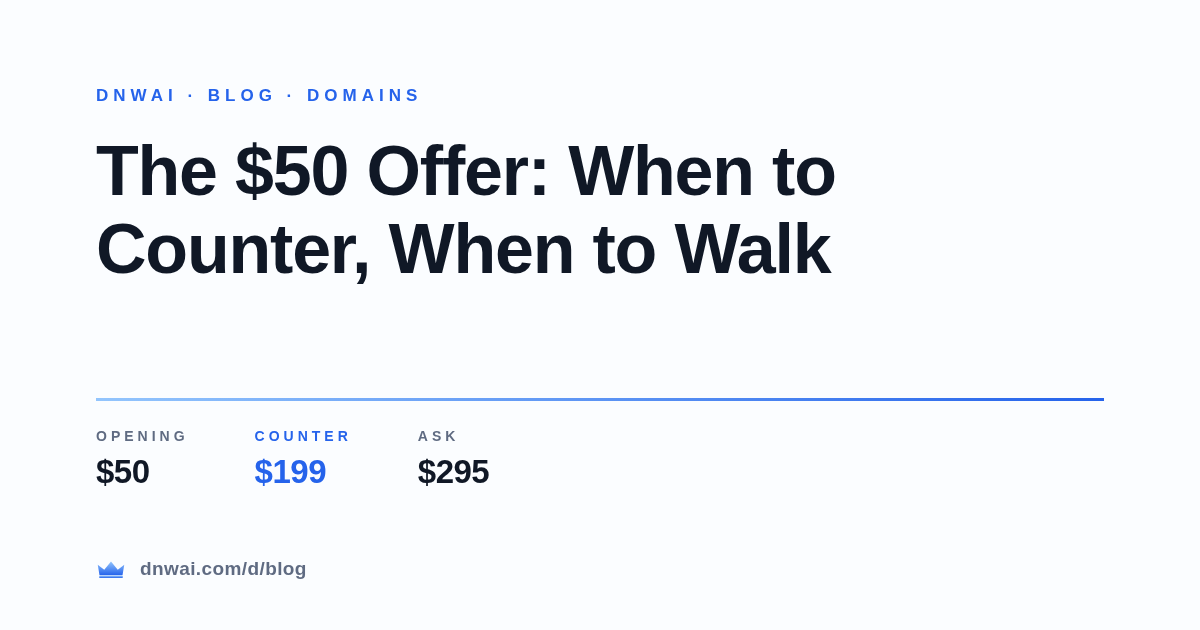
The $50 Offer: When to Counter, When to Walk
Fifty dollars arrived in a reply to an outreach email this month, against a $295 asking price. In a campaign whose hundred inbound messages we read by hand, that one line of text was the most valuable thing in the mailbox — not because $50 is a good price, but because it was the only message written by a human who named a number. The rest was newsletters, receipts and autoreplies.
An opening bid is a decision point. What follows is the work a lowball forces: whether to counter, and at what point you walk. We use our own thread as the example because the ticket is small enough that nobody's ego is doing the pricing at $50.
What a $50 offer actually tells you
Read it as information first. Three facts arrive with it, and none of them is the number itself.
- Someone read the listing. Across a hundred inbound messages, two were human. A message that names a price is worth more than the ninety-eight that did not, whatever the price is.
- The gap is being treated as negotiable. A buyer who believed $295 was final would have closed the tab. Writing a number means they want the name and expect to argue about the price.
- The buyer has not done the work. $50 against $295 is a probe, not a considered figure: the smallest number that keeps the conversation alive. A buyer who had compared sales in the class would have opened higher.
What the offer does not tell you is whether they will pay $199. Some lowballs come from buyers with a real budget and a habit of starting low; some from buyers with no budget at all. The counter is how you find out, and it costs one email.
The arithmetic nobody runs
Gross prices flatter a decision. Net numbers change it.
Take the two prices, subtract the cut a marketplace or escrow takes, and put them side by side. At 10% — Atom's rate on auction sales, with a $3 minimum — $50 nets $45 and $199 nets $179.10, before payment and transfer costs. At the 30% end of the retail band the same two prices net $35 and $139.30.
Then subtract what the name costs you to keep. One renewal year on the cheapest .com paths is around twelve dollars; on most extensions it is more. Call it one year of renewal either way.
- Accepting $50 nets roughly three to four renewal years on a cheap extension, and fewer on an expensive one — and the name is gone.
- Countering at $199 nets the same number of renewals, an order of magnitude deeper — and if the counter dies, you still hold the name plus the renewal you were going to pay regardless.
That last line is the whole case for countering. The downside of a counter is one email and a quiet thread; the downside of accepting $50 is a sale at a price that will be quoted back at you the next time you list anything in the class.
The floor is a number you set before the offer arrives
A floor is not a feeling about the name. It is a number you write down before anyone offers anything, derived from receipts rather than from an appraisal. Our order of operations:
- Find sold prices, not asking prices. The Worthly.si index we read on 16 October 2026 tracks 291 .si sales with a median of $2,600, an average of $4,403 and a high of $50,000 — and its method note states that asking prices are excluded. A sold price is the only number in the chain that someone actually paid.
- Discount for the cost of time. A sale in six months is worth less than the same price today, and a name that renews twice while you wait has to clear both renewals.
- Write the floor down, and decide the walk-away above it. Once the number exists on paper, a $50 offer stops being a judgement call. It is either above the floor or below it.
We ran that sequence on the name behind our $50 offer; the floor came out well above $50, which settled the first decision immediately and left only the number to send back.
Why the counter was $199 and not the midpoint
The midpoint between $295 and $50 is $172.50. We did not send $172.50, and the reason is not that we wanted more money. Two things decide a counter's number.
A midpoint counter tells the buyer the ask was fiction. If $295 becomes $172.50 in one move, it can become $120 in the next, and the buyer learns your price is a mood rather than a measurement.
A counter should be a number you already publish. $199 was not invented for the thread: one name in the same portfolio carries that exact price on our own listing page. A number that exists on your price sheet is defensible in one sentence; a number made up mid-thread is not defensible at all.
So the counter did two jobs at once. It moved the buyer from $50 to $199 — an increase of nearly 300% from where they started — while cutting our ask by a third, which is a visible win on their side of the table. Both parties keep a story, and the remaining gap is $96 instead of $245.
Why the deadline is 72 hours
A counter without an expiry is a request, not a decision. Three things change once the clock is real.
- The buyer has to choose. "I'll think about it" is free when there is nothing to lose, and expensive when the price reverts on Thursday.
- You get your inventory back on a known date. The name stays listed at its price, and you can plan around that instead of waiting on a thread.
- Option-buyers identify themselves. A buyer who wanted a free call on the name for a month cannot get one from a deadline.
Seventy-two hours covers a weekend and a partner's opinion, and is short enough that nobody forgets the thread. It is now a rule on every counter, not a flourish on this one.
When to walk
Four cases, all of which we have run into, and each one ends the negotiation without a counter.
- Below the floor, with no engagement in the message. A $50 bid that says, in effect, "for this one" is a probe. A $50 bid that explains the rebrand it is for, names the alternative it lost to, and asks one specific question is a different email — and occasionally worth a discount, because you are now arguing with a plan rather than a number.
- The buyer wants a valuation before raising the offer. A $200 negotiation cannot fund a $400 appraisal; if a certificate is a condition of the number moving, the buyer is shopping, not buying.
- The offer is being used as an option. The shape is always the same: a low number, then questions for two weeks, then no commitment. You are financing someone else's diligence with your inventory, and the inventory is the only thing in the transaction that expires.
- The venue changes what $50 means. On Atom's wholesale liquidation format, $50 is the format's own starting price — no reserve, and the price steps down by $10 a day to a floor of $10. A $50 bid there is the mechanism working as designed; a $50 bid against a $295 retail ask is an opening move in a different game. A venue's floor is not your floor.
The counter email, in three sentences
The email we sent has a shape worth reusing. It contains one line of receipt, one number, and one expiry.
- The receipt: not "this name is valuable", but one comparable and what it paid. One is enough.
- The number: a single figure, with no range around it.
- The expiry and the consequence: the date and time the price reverts, and what happens to the listing after it.
No apology, no explanation of your costs, no second number hedged behind the first. "$199, but we could do $175 for a fast close" is two counters in one email, and it costs you both: the buyer learns the floor is under $175 and that you will move again.
One number, one deadline, one sentence about what happens next.
Where this thread stands
Honesty is worth more here than a tidy ending. The counter went out at $199 with 72 hours on the clock. We are not reporting a sale, because there is not one to report — a counter is a decision point, not a closing.
What the thread has already produced is worth keeping regardless of how it ends: a floor derived from sold prices, a published number rather than an improvisation, and an expiry that returns the name to the market on a known date.
Four rules we now run on every named offer
- Answer every named number within one business day. Speed is the cheapest concession you own; silence reads as disinterest or desperation.
- Set the floor before the offer, from sold receipts. A floor invented after the bid arrives is a rationalisation, and buyers can hear it.
- Counter once, at a published number, with an expiry. Never counter twice in a downward direction; each lower counter teaches the buyer that your numbers move when pressed.
- Walk in writing, and log the number. Close the thread politely, keep the name at its listed price, and record what was offered. This month's lowball is next month's pricing data — and, occasionally, the opening line of a negotiation that closes six months later at the price you refused.
Sources and method
- The hundred-message campaign figures — 100 inbound candidates, 57 after removing marketing mail, 23 in "Re:" form, 2 written by a human — are as published in our 11 October 2026 note on cold outreach replies.
- The $50 offer, the $295 asking price, the $199 counter and the 72-hour deadline come from our own outreach thread of 11 October 2026. No sale is claimed in this piece, and none is being implied.
- Atom's auction commission — 10%, with a $3 minimum — and the retail Premium band (30/25/20/15%) are quoted from the platform's published rate tables.
- Atom's wholesale liquidation format — $50 start, no reserve, a $10 daily decline to a $10 floor — is quoted from the platform's seller documentation.
- Worthly.si sales index, read 16 October 2026: 291 tracked .si sales, median $2,600, average $4,403, highest $50,000, asking prices excluded by the index's own method note.
- Renewal figures are the renewal prices shown for our own names and vary by extension; the twelve-dollar reference is the cheap end, not a portfolio average. The $199 and $295 figures both appear as live prices on our listing page at dnwai.com/d.
Buying a name this week?
154 exact-match, brandable and geo domains — buy-now price, escrow-protected, same-day transfer. See the portfolio · the contact page