
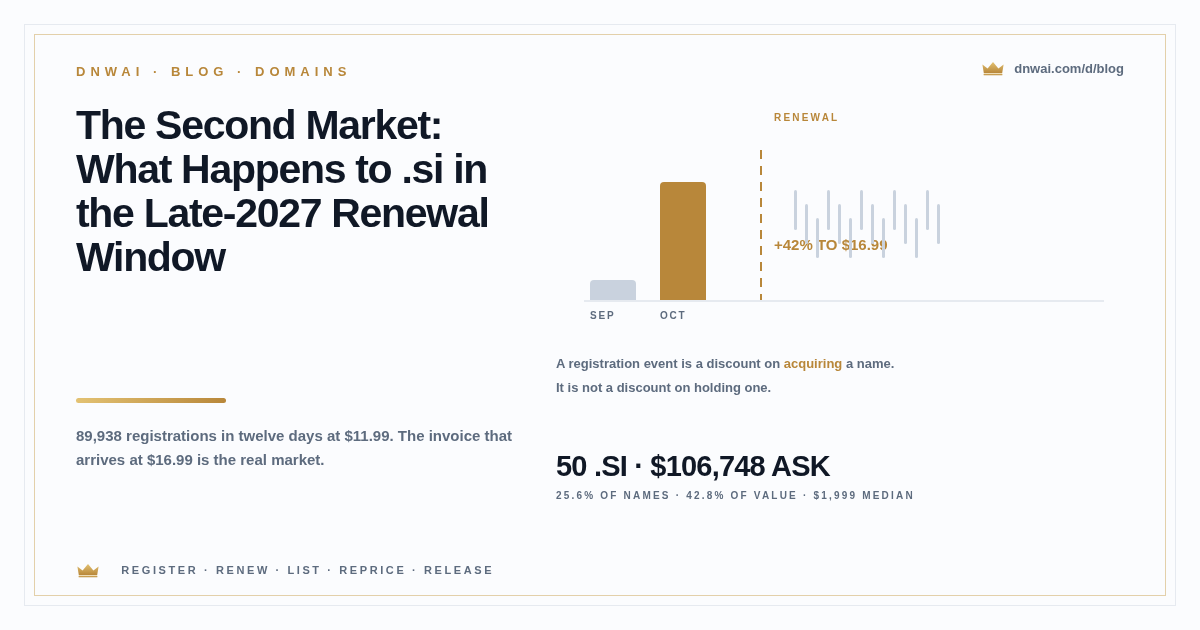
The Second Market: What Happens to .si in the Late-2027 Renewal Window
The .si registry added 89,938 names in twelve days in October 2026. A year from now those registrations become renewal decisions, and the arithmetic behind each one is decided at $11.99, not at $5,008. Here is the window, the shelf that has to survive it, and the four numbers we check before paying an invoice on a name.
Most of the conversation about a ccTLD boom happens at the top of the market: a $50,000 close, a $5,008 median, a twelve-day registration spike. All three describe the event from the buyer's side and are silent about the part that decides whether it lasts — what happens when those names stop being cheap.
That question is not speculative: it has a date on it, and the date is the registration month plus one. The renewal is the second market — the one nobody prices in a launch post, and the one that decides which of those 89,938 names still exist in late 2027.
What actually happened in October
The registry held 198,535 .si names on 23 September 2026. On 5 October it held 288,473. That is 89,938 new registrations in twelve days, a 45.3% jump in a namespace that had grown slowly for years, at a pace near 7,500 names a day.
The price that produced the surge is on every registrar's page: $11.99 for the first year at a retail registrar, or 10 euros at the registry. Both are first-year numbers. The renewal is the one printed in smaller type, and the published figure we have been quoting all year is $16.99. That is a 42% step up between the year that was advertised and the year that follows it.
None of this makes the October window a mistake. It makes it a promotion with a due date: a registration event is a discount on acquiring a name, not on holding one.
Two markets under one extension
The aftermarket and the registration layer behave so differently that they are easier to think about as separate markets that happen to share a suffix.
The reported market is small and expensive. As of 12 October 2026 the tracked .si market showed 103 reported retail sales in 2026 against 29 in all fourteen earlier years combined. The median sale is $5,008, up from $3,050 in the years before, and 59 sales cleared at $5,000 or more.
The registration layer is enormous and cheap. 89,938 new names in twelve days at $11.99 — the same four weeks in which staffing.si reportedly cleared at $50,000. The distance between the two figures, roughly 4,170 to one, is not a market malfunction. It is what a namespace looks like when the acquisition price and the resale price are set by completely different forces.
The bridge between the two markets is the renewal. A name has to survive at least one renewal year to appear in the reported market at all, and most of the 89,938 will not: they were never priced, never listed and never offered to a buyer. Registered is not the same as in business.
The shelf that has to survive the window
This is not an abstract exercise for us. Our own portfolio page read on 16 November 2026 carries 195 live names with a buy-now price, and 50 of them are .si.
Read as one shelf, the .si portion is the most valuable part of what we hold. It is 25.6% of the names and 42.8% of the asking value: $106,748 of a $249,263 total, at a median ask of $1,999 against a $1,170 median across the whole portfolio. The .com side is 138 names at a $940 median, and the seven .net names sit at a $350 median.
Here is the part that matters for the renewal window. Distribute those 50 .si names across price bands:
- One name under $500, at $450.
- One name between $500 and $999.
- 24 names between $1,000 and $1,999.
- 19 names between $2,000 and $2,999.
- Five names at $3,000 or more, the highest at $5,300.
Nothing on the .si shelf is priced near the cost of its own renewal. The cheapest name is 26.5 years of renewal at $16.99. The median of $1,999 is 117 years. The $5,300 name is 311. That ratio is the entire argument for holding a .si name: the instrument is long-dated, the carrying cost is trivial, and the decision to keep it is not a cash decision.
Fifty renewals at $16.99 come to $849.50 a year. Five years of holding the whole .si shelf costs $4,247.50 against $106,748 of asking prices. No plausible price cut is as expensive as dropping a name that later sells.
Why the late-2027 decision is different for the new buyers
Our shelf was built by picking names, one at a time, with a price in mind before the registration was paid. The October cohort was built the other way around: the price came first, at $11.99, and the name came second, from whatever was still available after 89,938 registrations had gone through.
That difference shows up exactly one renewal later, and it shows up as three questions that a seller of a good name never has to answer:
The name was never priced. A registration without a listing is an unlisted asset. When the renewal arrives, the owner is deciding whether to pay for an option that has no published strike price, and the temptation is to renew because $16.99 feels like nothing. It is nothing individually and real collectively. Ten such names is $169.90 a year for inventory nobody has ever been offered a chance to buy.
The name has no second party. The aftermarket median of $5,008 is a median of 103 reported sales, which is a market of hundreds of names, not 89,938. The probability that any specific new registration is in that market is small, and the only way to change that is to list it and send it to someone. A name that has never been listed cannot be assessed for renewal, because there is no evidence yet.
The name's only comparable is its neighbor. In a namespace that added 45% in twelve days, every name in that cohort has a huge supply of near-identical alternatives registered in the same fortnight. Scarcity, which is what a narrow extension normally sells, is temporarily inverted. That is a reason to price low and sell during the wave of attention, not to hold and hope the wave lifts the price.
What the renewal window actually looks like
Twelve months is the rhythm, and the 60-day window before expiry is where the useful decisions live. Every registry described in this blog's earlier work behaves the same way: a grace period after expiry, a restore period after that with a much larger fee, and a redemption window in which the name is technically recoverable and practically expensive.
We do not treat the grace period as a workspace. A name inside its grace window is neither for sale nor safely held, and every day spent there is a day of the year that produced no attempt at a sale. So the calendar is built backwards from the invoice:
- Ninety days before expiry: read the price sheet, decide renew, reprice or release. One line per name.
- Sixty days before expiry: if the answer is reprice, publish the new number now, while there is still a full quarter of listing life left.
- Thirty days before expiry: if the answer is release, stop advertising it. A name you intend to drop should not be collecting enquiries you cannot service.
- At expiry: anything undecided renews by default, which is how a shelf drifts into a bill it cannot justify.
The only names that get an automatic renewal on our own shelf are the ones where the sentence takes no thought: listed, priced, and either generating enquiries or sitting in a catalogue a buyer can reach. Everything else comes off the sheet before the invoice.
Reading an expiry date as a buyer
If you are the one buying rather than holding, the expiry date is not a footnote. It is a signal about the seller's position, and it is public in a whois lookup.
A .si name with 200 days left is a name its holder is comfortable keeping. A name with 12 days left and a live listing has a holder deciding whether the listing or the invoice is worth more, and that is a different negotiation: the seller's alternative to your offer is not holding forever, it is paying again.
We use this in both directions. On the sell side, we move expiring inventory onto the sheet first, because a name that sells in the sixtieth day before expiry beats a name that sells six months after it. On the buy side, expiring names in a namespace that just added 89,938 registrations are the least scarce inventory in the extension, and an offer should be priced accordingly.
The one thing an expiry date cannot tell you is whether the name is worth buying, and a short expiry just moves the negotiation rather than changing the answer.
The four numbers we check before paying a .si renewal
After a year of running this shelf, the check is short and there is no fifth number.
One: years of cover. Asking price divided by the renewal. Under about ten and the name is inventory pretending to be an investment; the invoice will keep competing with the sale. Every .si name on our shelf is far past that line, which is exactly why the shelf holds them.
Two: the listing exists. A name with no published price gets priced, or it gets released. This one rule removes the largest source of quiet renewal spend we have found, because unlisted names renew by default forever and nobody ever asks them to justify it.
Three: evidence of a market. A single enquiry in a year, or a single offer at any price, does more for a renewal decision than any appraisal. It is the difference between a hypothesis about demand and a data point about demand.
Four: the year's plan. If the plan for a name over the next twelve months is nothing but holding it, the renewal buys an option and should be budgeted as one. If the plan is a listing, a price change, or one campaign, the renewal buys something concrete, and that is a different — and much easier — yes.
Buying a name this week?
195 exact-match, brandable and geo domains — buy-now price, escrow-protected, same-day transfer. See the portfolio · the contact page
Buying a name this week?
193 exact-match, brandable and geo domains — buy-now price, escrow-protected, same-day transfer. See the portfolio · the contact page