
Selling to Agencies: The Naming Brief That Precedes a Purchase
The first time someone from a creative agency replied to one of my emails, I expected a negotiation. What I got was a question about a client brief I did not know existed. They were not buying a name for themselves. They were buying one for a founder who had already approved a category, a budget, and a launch date, and the agency was the one making the shortlist.
That reply changed how I write to agencies. Most sellers treat an agency like any other prospect: here is a name, here is the price, please reply. But an agency is a different animal. It rarely decides alone, it almost never pays from its own pocket, and it is measured on how fast it can show its client options. If your email does not fit the shape of the brief that is already open on their desk, it is noise.
This is what the brief looks like, and how to answer one before the client has even named it.
The name arrives after the decision, not before
There is a sequence in agency work that sellers routinely get backwards. The client agrees the strategy, then the positioning, then the personality, and only then does somebody remember that all of it needs a word attached. By the time a name is discussed, the client has already said yes to a direction in a meeting. Nobody is open to being convinced. They are open to being finished.
That single fact explains almost every agency reply that goes nowhere. You offered a name with a story attached to it. They needed a word that confirmed a decision that had already been made two weeks earlier, in a room you were not in. When a studio says a name is interesting but not right, they are not being polite. They are telling you the brief points somewhere else, and they are usually right about their own client.
The practical consequence is that agencies are easier to sell to than founders and harder to surprise. You do not have to create desire. You have to fit a slot.
What the numbers on this shelf actually say about who buys
I run a small portfolio of 195 names, listed at a total ask of $249,263 with a median of $1,170 and a range from $120 to $5,300. That is a shelf aimed at people who have a real budget but not a corporate one. Sixty-one of those names, just over 31%, are priced ending in 95 or 99. That is not a design taste. It is what happens when you price against individual decision makers rather than procurement.
Agencies are different in two ways that matter. First, the money is not theirs, so a $4,000 name that terrifies a solo founder is unremarkable to a studio that bills more than that for a logo. Second, they are shopping inside a deadline. A client approved the brief on Monday and wants names by Thursday, and the studio will take the third-best option that arrives today over the perfect one that arrives next week.
That is the asymmetry to exploit. It is not that your name is better than the others in their shortlist. It is that you answered in the format they can forward to a client without editing it.
The four fields every naming brief has
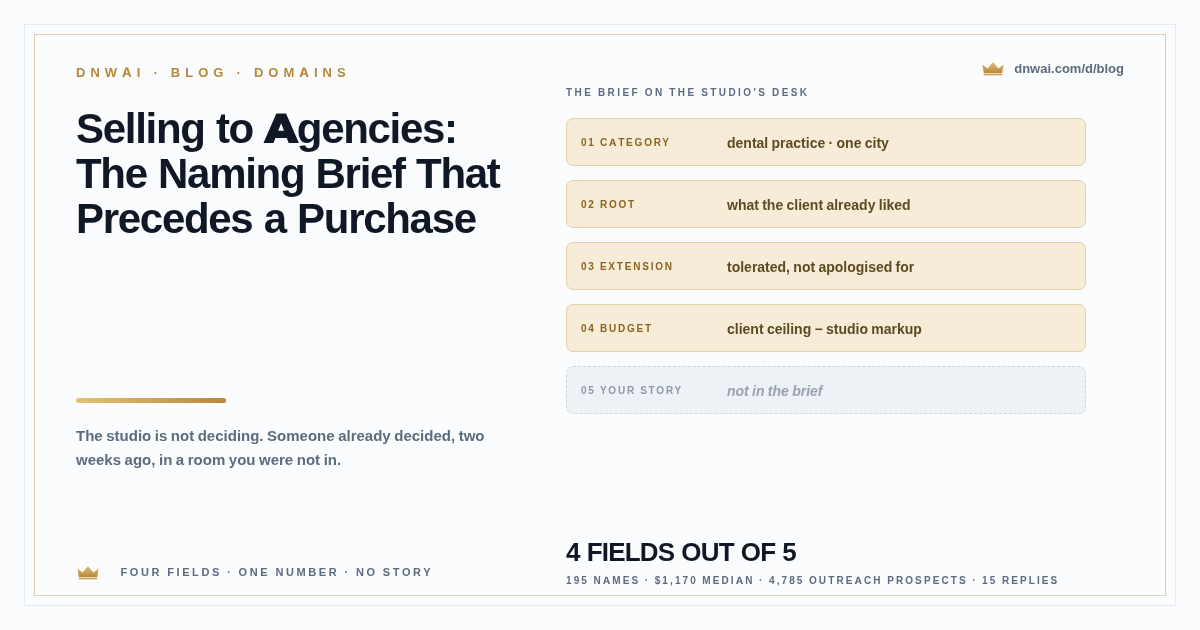
Strip away the fancy agency language and a brief has four fields. They are always present, even when nobody writes them down.
The first is the category. Not the industry in a broad sense, but the specific job the company does for a specific customer. A studio building a brand for a dental practice in one city is not looking for a dental name. It is looking for a name a patient can spell after hearing it once on the radio.
The second is the root word or stem. This is where the real filter sits. The client has already reacted to something in the first meeting, and the agency is looking for names that carry the same feeling with a different letter pattern. You do not know which root it is. But you can offer two directions instead of one, and let them pick the one that matches the brief they cannot show you.
The third is extension tolerance. This is the field sellers ignore and should not. An agency building a brand for a modern company will accept a .com if it is short and clean, and will happily present a .si or a .net if the name is strong and the client is not defensive about it. What it will not do is present an extension it has to apologise for. If your only argument for the extension is price, an agency is the wrong buyer.
The fourth is budget, and it comes with a gate. Agencies talk in ranges, not numbers, and the range they mention is usually the client's ceiling minus their own markup. When an agency asks what you can do on price, they are usually already thinking about the retainer, not the registration.
Why the reply that works is short and organised
The instinct when a studio shows interest is to send everything: the full story of the name, every similar domain you have, three paragraphs on why the keyword is valuable. That is the wrong move, because every extra paragraph is another thing the agency has to summarise for a client who did not ask for a domain at all.
What works is closer to a spec sheet. One line on what the name is. One line on the audience it fits. One line on the alternative in a different direction, in case the brief points the other way. One line on price and terms, with a number rather than a range. And one line saying the name is available immediately on a platform that handles escrow, so nobody has to take a stranger's word for it.
If the name sits in a series, say it plainly. Over my shelf, 138 of 195 names are .com and 50 are .si, and the .si block is where the two-word business names live: pet sitting, tree services, glass repair, driveways, chauffeurs. A studio that needs a family of names for a client with several sub-brands can do worse than hearing what else exists in the same family. That is a genuine reason to reply to a follow-up email that a solo seller would get ignored for.
The part that makes agencies slow, and how not to lose them
An agency will go quiet, sometimes for two weeks, and it will not be about your name. It will be about the client. The decision has moved from the creative director to a marketing manager, then to someone whose job is to approve anything with a recurring cost. The name is one line in a deck. Nothing is wrong.
The mistake in that silence is to follow up with pressure. A discount after eleven quiet days reads as a seller who is nervous, and a nervous seller invites a much lower counter. The move that keeps a deal alive is to follow up with a fact: the name is still available, the price holds until a named date, and here is one more name that fits the other direction in the brief. That costs you nothing and gives the studio something to send internally.
I have watched my own campaigns long enough to know how much of this is luck. Across the campaign folders I can read locally, there are 4,785 prospects, of which 4,016 emails are unique domains, and 3,746 of those appear exactly once. That is what outreach to small businesses looks like: a long tail of one-off addresses, not a small set of accounts you can work repeatedly. Only 15 replies are marked in those same files, and most of the replies came after one, two, or three touches rather than at the end of a four-step sequence. The stop-signal matters more than the extra touch.
The agency is your cheapest research budget
The unexpected benefit of writing to studios is not the sales. It is the free feedback on how your shelf looks to people who name things for a living. Ask one honest question in a reply: which three names on the shelf would you have shortlisted, and what was missing. Half will ignore it. The ones who answer will tell you more about your inventory in two sentences than a month of appraisals.
If the answer is consistently "we needed something shorter", that is a statement about the shelf, not about the buyer. If three studios tell you the two-word business names are easy to place and the coined brandables are hard to justify to a client, that is a pricing signal worth acting on, and it costs you nothing beyond one sentence in an email you were going to send anyway.
What to do before your next send
Build one agency email per name, not one email that fits everything. Name it for the specific client type the agency serves, give two directions, put a number on it, and stop. Do not attach the story of why you registered it. Do not apologise for the extension. Do not send a second version of the same email an hour later with a lower price.
Then track the one number that actually tells you whether agencies are worth the effort: how many of your agency emails get a reply that asks a question. A question is the only reliable sign you are in a live decision. A price objection from an agency is usually not a decision at all, it is a request for something to put in the deck.
The names that sell to studios are rarely the cheapest on the shelf. They are the ones that arrive in a format where the client can say yes without asking anyone a follow-up question.
Buying a name this week?
193 exact-match, brandable and geo domains — buy-now price, escrow-protected, same-day transfer. See the portfolio · the contact page