
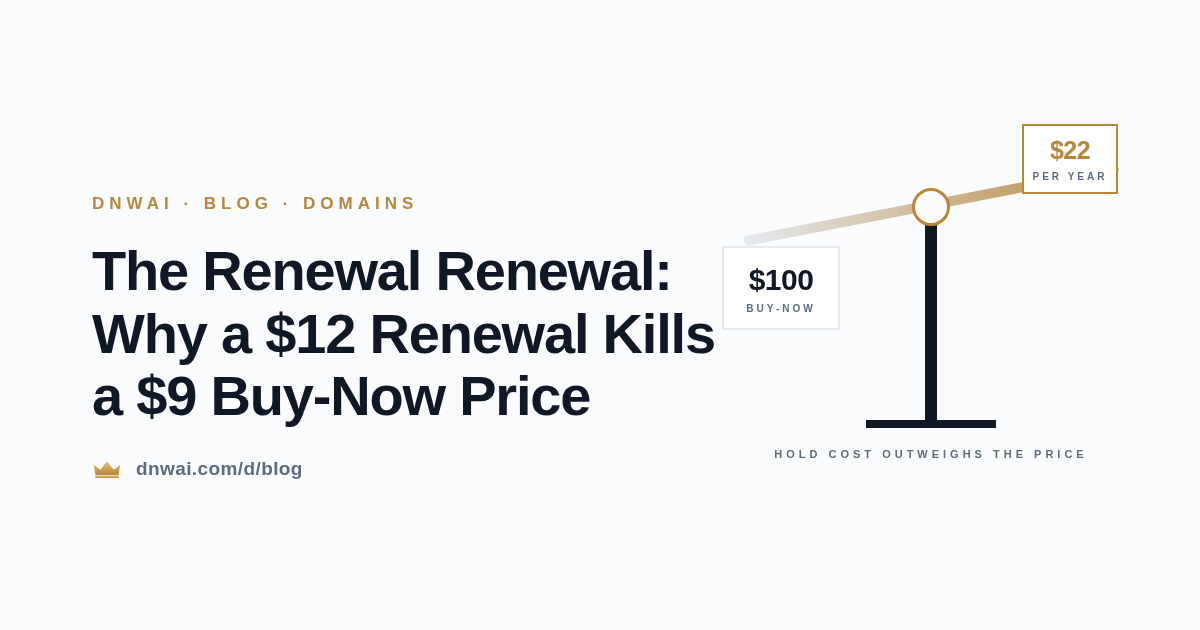
The Renewal Renewal: Why a $12 Renewal Kills a $9 Buy-Now Price
A domain portfolio is a stock of prices and a flow of invoices. Almost every decision a seller makes is about the stock: what a name is worth, what to list it at, what to accept. The invoice arrives later, quietly, once a year, and by then the listing price is already a decision you have to live with. This article is about the place where the two numbers meet, and the reason I now start with the invoice.
The claim is narrow. A renewal is not a cost you pay for holding a name; it is a cost you pay for holding the option to sell that name for another twelve months. Priced that way, a cheap buy-now is not a modest, low-risk exit. It is a long option that has to be repriced every year, and at the bottom of a price sheet the repricing can exceed the sale.
The ledger I am working from
Our own shelf on 13 November 2026: 195 live names on the portfolio page, 181 of them in the marketplace export that carries prices, appraisals and expiry dates. Of those 181, 171 are buy-now listings and 10 are make-offer. The priced median is $495. The total of every asking price on the shelf is $153,008.
The renewal side is less tidy, because our names sit across three extensions with three different registry bills. The .com renewal runs $12 to $22 depending on where it was registered and whether it is on a promo that has since lapsed. The .si names renew in euro, and the last invoice we reconciled put the whole shelf's annual renewal bill near $2,124 at the cheap end of the range. That is the number I keep coming back to: $2,124 a year, spread across 181 assets.
Expiry dates in that export, read against today. Thirty-five names expire in November 2026. Nine more in December. Sixty-nine fall inside the next 180 days and all 181 fall inside a year. The median time to expiry is 190 days. Two names are already past their expiry date in the export, which is normal and expected — a stale export, or a renewal that has been paid but not yet reflected at the registry. Either way, it means the list needs reading, not trusting.
The bottom of the price sheet
Eight of the 181 names carry a $100 buy-now price. Six more are at $150. The .net names go as low as $120 and $150. The cheapest .com is $195, and there are two of those.
Now do the arithmetic that a seller rarely does in one sitting. Take a $100 name. The shelf's stated renewal bill averages out to something near $12 a year, which sounds like nothing against $100 — a 12% hold cost, the kind of number that lives comfortably in a spreadsheet. But that average folds .si renewals into .com renewals and hides the top of the range. Use the high end, $22, and the same name costs 22% of its asking price every year to keep listed. Keep it for five years without a buyer and the renewals have consumed $110 against a $153,008 shelf total that included the sale that never happened.
The real problem is not the ratio. It is that the price you published was calculated as if the renewal did not exist, and the renewal is not negotiable. You can discount a domain by 10% in an afternoon. You cannot discount a registry invoice.
Where the two numbers cross
Define the break-even hold: the number of years a name can sit at its asking price before cumulative renewals equal that price. For the shelf as a whole at a $495 median and roughly $12 a year, that is about forty-one years — which is why the shelf-level arithmetic always looks fine and why nobody fixes anything.
For the $100 tier at a $22 renewal it is four and a half years. For a $120 .net at a $15 renewal it is eight. For the .si names at the top of the price sheet it is measured in centuries and the renewal question disappears entirely.
This is the asymmetry the title is about. On a $4,999 name, a $12 renewal is a rounding error and the renewal never enters the conversation. On a $100 name it enters every single year, and the decision it forces is not "should I hold this" but "should I keep publishing a number so low that the hold cost is the main cost". The bottom of a price sheet is not the safe end of the portfolio. It is the end where the invoices are the largest fraction of the proceeds, and where a sell-side margin is thinnest.
The 35 names that made me look
November 2026 is the heaviest expiry month in the ledger: 35 names, roughly a fifth of the export. That is not a coincidence any more than a lease renewal is — names bought in the same month over consecutive years renew in the same month, because we tend to buy in campaigns rather than steadily. A portfolio built in bursts has a lumpy renewal calendar, and the lump is where the cash goes.
So the useful question about expiring inventory is not "is this name good". It is "what does this specific name have to do in the next twelve months to justify another invoice". Four things qualify and they are cheap to check:
- It has been listed and priced. A name with no listing is not an asset in play; the invoice buys nothing but optionality with no price attached.
- Its price is above the renewal's cross-over. At $22 a year, anything under roughly $200 is in the zone where hold cost competes with the sale itself.
- It has traffic or a lead. One enquiry in a year does more for a renewal decision than a score does, because it proves a market exists.
- It is not sitting under a trademark we have not screened. A held name with a screen failure is a liability with a carrying cost.
Everything else on the list — the name that scored 5.9, the name with 42 TLDs taken, the appraisal that comes in nine times the asking price — is decoration around those four.
Appraisals do not settle it
One more number deserves a warning, because it will tempt you to keep everything. Of the 152 names in the export with an AI appraisal, 136 carry an appraisal higher than the asking price. The median appraisal is $1,699 against a $495 median ask, and the sum of every appraisal is $269,448 against $153,008 of asking prices.
That is not a discovery of $116,000 of hidden value. It is a sign that an appraisal reads the name in isolation, while a price has to survive a buyer's budget and a seller's patience. An appraisal does not pay an invoice. If you use it as a reason to renew, you are using the least cash-relevant number on the sheet to make the most cash-relevant decision.
What we do with a renewal, in order
This is the sequence I run on every expiring name now, and it takes about four minutes once the export is open:
- Sort by expiry, not by price. The invoice is the deadline; the price is not.
- Price against the hold, not the appraisal. If the asking price is under ten times the annual renewal, the name has to earn its renewal in the next twelve months or come off the shelf.
- Decide before the renewal date, not at it. Registry grace periods are real but every day inside them is a day where the name is neither for sale nor yours to keep calmly.
- Record the decision. Renew, reprice or release — one line per name, with a date. An undecided name gets renewed by default, and default is how a portfolio drifts into a bill it cannot justify.
The $100 tier survives this sequence, but it survives as a deliberate choice rather than as the place cheap names go to wait. Some of those names are worth the invoice: a geo .com bought in a city campaign, a functional .net that answers a search nobody else answers. Others are worth exactly one renewal, and finding out which is the whole point of doing the arithmetic before the invoice instead of after.
The line I would give another seller
Price every name as if you are going to hold it a year and then explain the renewal to yourself in one sentence. If the sentence is "it is only twelve dollars", the name is probably fine and the number is irrelevant. If the sentence is "the renewal is not what I am worried about", you are still thinking about the stock. The flow is the thing that arrives whether or not you sold anything.
Buying a name this week?
193 exact-match, brandable and geo domains — buy-now price, escrow-protected, same-day transfer. See the portfolio · the contact page