
Renewal During a Pending Sale: Who Pays and Why It Matters
The offer is accepted. The escrow is open. The buyer has wired the money, the seller has sent the auth code, and both sides believe the hard part is over. Then a renewal invoice lands in the seller's inbox, the transfer portal returns an error on day four, and the deal that looked finished sits unmoving for another two weeks while two people who stopped negotiating a week ago try to remember who promised what.
Renewal is the least discussed and most common deal-breaker in the domain market. It is not a dramatic failure. Nobody loses a five-figure name to a scam here. What happens is quieter: a name renews on a card that expires, an account gets suspended, a transfer is attempted inside a lock window, and a buyer with a purchase agreement in hand starts to wonder whether the seller is still in control of the asset.
This post is about that narrow window — from accepted offer to completed transfer — and the renewal date that sometimes lands inside it. All the portfolio numbers below are computed from the live listing page today: 195 names, 138 .com, 50 .si and 7 .net, with a total ask of $249,263, a median of $1,170 and a range from $120 to $5,300. Those numbers matter here less for what they say about pricing than for what they say about scale: at 195 names, a portfolio this size hits a renewal date roughly every day and a half. Some of them will always fall inside a transaction.
The three things that actually clash
When people say "renewal problem during a sale," they are usually describing one of three distinct collisions, and the fix is different for each.
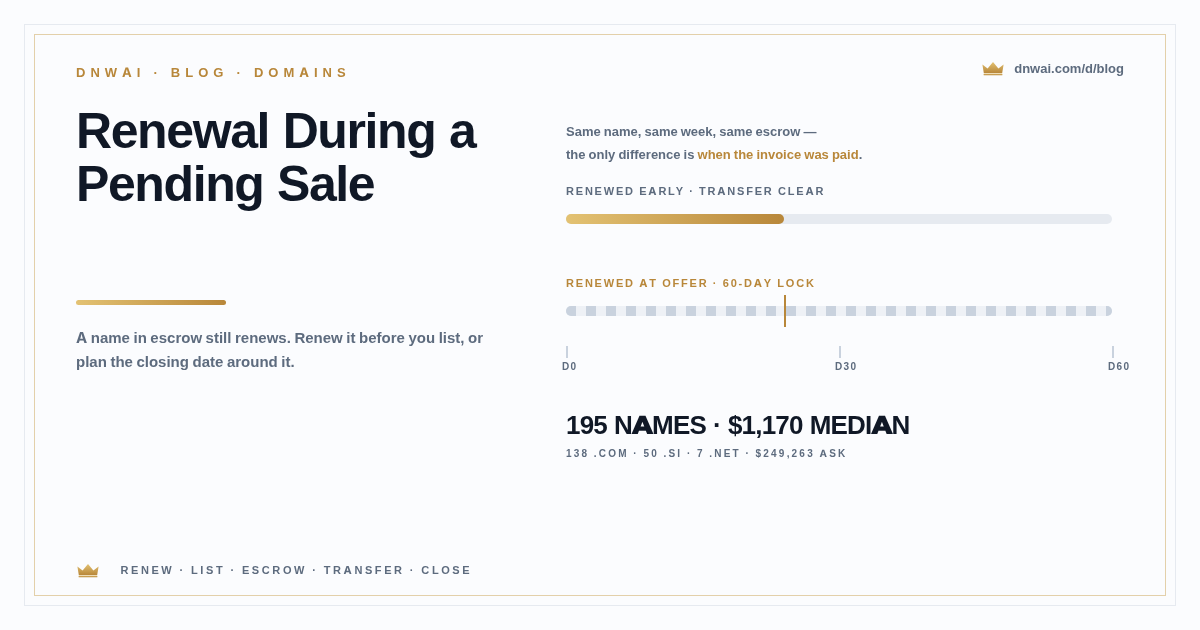
The first is a registry transfer lock. For most gTLDs, a registrar places a lock after any owner-facing change, including a renewal in some cases and definitely including inter-registrar transfers. The lock is commonly 60 days. A name that renews mid-escrow and then attempts to move to the buyer's registrar can be refused at the registry level, not by anyone being difficult.
The second is payment timing. Escrow releases funds after the transfer completes, not after the buyer pays. The seller funds a renewal out of pocket during a transaction in which they have not yet been paid. That is a cash-flow event, small in absolute terms, and it is the thing sellers complain about most.
The third is account state. A renewal that fails — expired card, declined charge, inbox not monitored — can put the name into a grace period, and a name in a grace period is not a name you want to be transferring. Registrars will generally refuse a transfer initiated while a domain is in a redemption or late-renewal state.
Only the first is a rule. The other two are bookkeeping. Nearly every stalled deal I have watched was a bookkeeping problem wearing the costume of a policy problem.
The seller pays, but not because it is fair
The norm is simple: the seller renews. The seller holds the credential until the transfer completes, the seller's account carries the risk if anything lapses, and the cost of one renewal year is tiny next to the price of a failed transaction.
A name listed at the $1,170 median in this portfolio renews for somewhere in the range of a dozen to a couple of dozen dollars a year for a .com, and roughly mid-teens for a .si, depending on current registrar pricing. On this shelf, one year of registration is a rounding error in a four-figure asking price, and it is smaller still on a .com that would list in the hundreds. Arguing over who pays eight to twenty dollars while a four-figure deal sits open is the worst hourly rate in this business.
But "the seller pays" is the wrong sentence to leave a buyer with, because it hides the part that actually matters: the renewal instruction has to enter the escrow conversation early, in writing, before the transfer is attempted.
The line that prevents the stall
What works is not a negotiation, it is a notification. When a sale starts, the seller sends one short message with four facts:
- The renewal date of the name.
- Whether the renewal has already been paid, and for how long.
- The seller's registrar, and whether the name is currently inside any lock window.
- A commitment that no account-level change will be made until the transfer completes.
That last item is the one people skip, and it is the one that causes the delay. Sellers tidy their accounts. They change registrant organization fields, they update contact details, they enable privacy, they move a card on file. Each of those is a change, and each of them can restart a clock the seller did not know was running.
A buyer who receives the four facts up front does not need to trust the seller's intentions, because the timeline is now a schedule instead of a hope.
Why the lock is a scheduling problem, not a legal one
The 60-day lock is often described as an obstacle. It is better understood as a constraint you plan around, the same way you plan around a weekend.
If the name was renewed 50 days ago, the transaction goes through escrow and completes normally. If it was renewed yesterday, the inter-registrar transfer cannot happen for almost two months, no matter how much everyone wants it to. There are two workable responses, and both require deciding before the auction closes, not after.
The first is to accept a longer closing date. Escrow holds the money, the buyer walks a security-reviewed path, the seller keeps the credential, and the transfer executes when the window clears. This is fine for a buyer who wants the name for a project in a year and terrible for one who wants it next month. Say which you are, early.
The second is a push instead of a transfer. If the buyer is willing to open an account at the seller's registrar, an intra-registrar account change is not the same operation as an inter-registrar move and is not subject to the same lock. It moves faster, and it leaves the buyer inside a registrar they did not choose. For a name at the lower end of this portfolio — a $120 to $499 listing is roughly 55 of the 195 here — a deliberate choice about registrar convenience is worth more than the savings on a year of registration.
Neither path is wrong. What is wrong is discovering the lock on the day of the transfer.
What I would do with a 195-name shelf
At this scale, renewal stops being an expense and becomes a schedule. A portfolio this size has a renewal somewhere roughly every day and a half, so any sale has a real chance of overlapping one.
I would keep a single calendar of renewal dates, not a folder of invoices. I would renew a name six to eight weeks before it comes up for sale, so that it never sits inside a lock window at the moment a buyer appears. And I would never time a listing to a renewal date I have not looked at in the last week.
The cheap version of this discipline costs a spreadsheet. The expensive version is a deal that dies at 95 percent completion while everyone blames the escrow company.
The renewal you should refuse to pay
There is one case where the seller should not simply renew: a name sold with an explicit agreement that the buyer will renew in their own account immediately after transfer, and a buyer who has already taken possession in practice — the credentials are with them, the project is live, the invoice is pending a minor administrative step.
That is the "pending sale" in the lazy sense, and it is not what this post is about. The moment money is in escrow and the name has not moved, the seller is still the operator of the domain. An operator who lets a name lapse because a sale is in progress has not saved a renewal fee. They have introduced a redemption fee and a question about whether the asset still exists.
The summary I would give a first-time seller
Renew the name yourself, out of pocket, before escrow opens if the date is close. Tell the buyer the date, the registrar and the lock status in one message. Do not touch the account during the transfer. If the lock is inside 60 days, choose between a longer closing date and an intra-registrar push, and choose it before the offer is accepted.
The cost of doing this is one renewal and one paragraph of writing. The cost of skipping it is a transaction that stalls at the exact moment when both parties have stopped being patient with each other.
A domain sale is a transfer of control, and control has a calendar. The seller who understands that calendar closes faster than the seller with the better name.
Buying a name this week?
193 exact-match, brandable and geo domains — buy-now price, escrow-protected, same-day transfer. See the portfolio · the contact page