
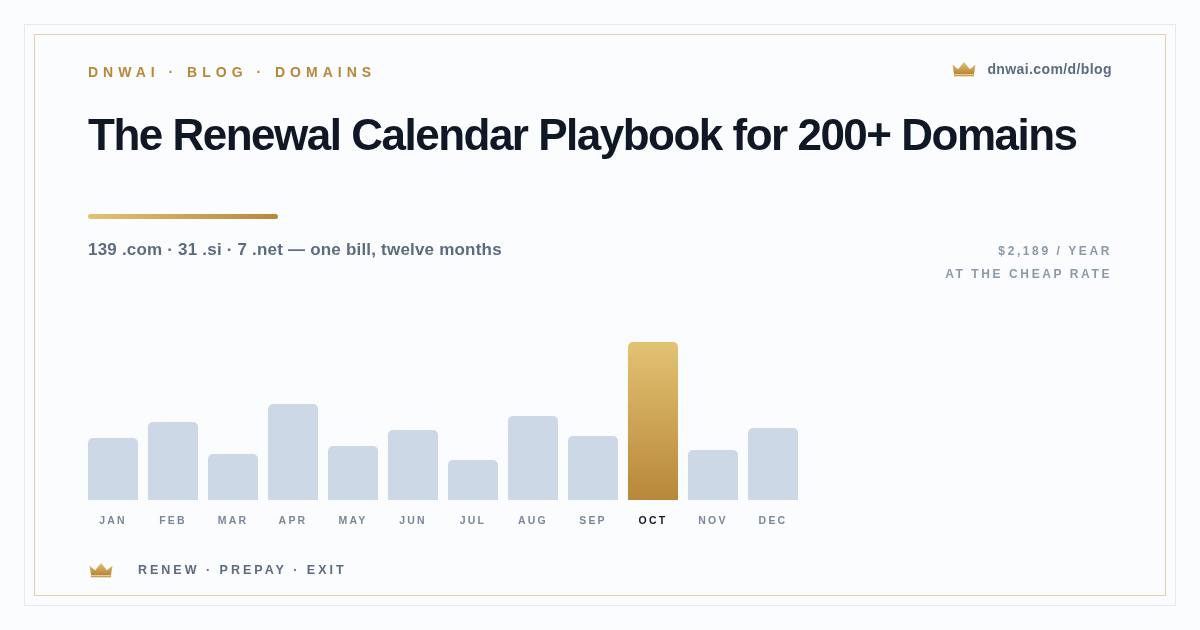
The Renewal Calendar Playbook for 200+ Domains
Every domain portfolio has one date that matters more than any listing, appraisal or outbound campaign: the day the renewal invoice arrives. On a 177-name shelf spread across three registrars and three extensions, that is not one date. It is a stack of them, buried inside a billing page you open twice a year.
This is the calendar we run instead, and the arithmetic that built it: our own numbers, the registry rules that decide whether a mistake is fixable, and the five checks that run every month.
What the 177 names actually cost to keep
Our public portfolio today prices 177 names: 139 .com, 31 .si and 7 .net. The asks run from $100 to $3,995, with a median of $495 across all three extensions — $488 on the .com names alone, $1,995 on the .si group, $195 on the .net group.
Renewals are not priced in one currency or one rate:
- .com — whatever the registrar charges this year. The spread between a cheap account and a retail account on the same name is roughly $12 to $22, which on 139 names is the difference between $1,668 and $3,058 a year.
- .si — a fixed registry cost, not a marketplace rate. Arnes charges registrars €10 per domain-year before VAT; the registrar's own price to us sits around €12–15 depending on who holds it. At €12 and today's rate (1 USD ≈ €0.89, so 1 EUR ≈ $1.12) that is about $13.40 a name, roughly $416 for the 31 names.
- .net — least of our worries at 7 names, still about $105 a year at a $15 rate.
Add it up at the cheap end and the bill is about $2,189 a year. At a $15 .com rate, $2,562. At $22, $3,535 — the same 177 names, a spread of $1,346 a year, moved by nothing but registrar choice.
That is why a calendar exists. Paying $3,535 and paying $2,189 for identical assets is not a pricing decision. It is a filing decision.
Why one invoice is the wrong shape
Registrars are happy to consolidate renewals, and consolidation feels like tidiness. It is a risk shape. One large invoice arrives in a month you did not choose, forces a decision on 177 names in one sitting, and turns an unforeseen cash month into a mass-expiry event you cannot unwind.
The fix is not to move every expiry — transfers rarely change the date, and for .si the registry is explicit that a registrar change does not alter the registration period. The fix is to know the curve and budget against it.
The twelve-month calendar
Five fields, one row per name, and a monthly job of twenty minutes:
- Expiry date — pulled from RDAP, not from memory. For .com that is the expiration event in RDAP; for .si it is the registry's own date. Both are free to fetch and both are authoritative.
- Registrar — because the renewal price and the grace-period terms belong to whoever sponsors the name today, not to whoever sold it.
- Renewal cost this year — the rate you would actually pay today, in the currency you would actually pay in.
- Ask price — what the name is listed at, so you can see whether the renewal is a rounding error against the sale.
- Decision — renew, prepay, reduce, or exit, decided once a year and not revisited at the invoice.
Four views, one question each:
- This month's expiries. The only list you act on now.
- Next month's expiries. The list you decide on calmly, while there is still time to sell or transfer.
- The 90-day list. Names expiring inside a quarter with no sale and no live enquiry — the exit candidates.
- The spend curve. Twelve columns of dollars, so the March spike is visible in January.
Once those four exist, the invoice stops being an event. It becomes a confirmation of a number you already wrote down.
The window that decides whether a mistake is fixable
Most portfolio owners learn this the hard way, and the rules differ by extension in ways that matter.
On .com, the registrar drives everything. After expiry the name typically sits in a registrar-level auto-renew grace window where it can be renewed without drama. Once the registrar deletes it, it enters the registry Redemption Grace Period — a 30-day hold during which it must be restored by that registrar, usually for a fee on top of the renewal. Only then does it reach the market. ICANN's registrant guidance describes this sequence and notes the redemption fee is set by the registrar, not the registry.
On .si, the rules are shorter and harder. Arnes publishes the sequence plainly: if the registry does not receive a renewal request, the name is placed in quarantine on the date the period expires. Quarantine removes the name from the .si DNS — it stops resolving. Quarantine cannot last longer than 30 days; without renewal the name is deleted and anyone can register it. Renewing during quarantine removes the status and reactivates the name.
Two consequences follow. On .si a missed renewal is not a payment problem — the name goes dark immediately, so a live site, a working email address and an in-flight sale conversation all stop at once. And a pending sale does not protect the name: the registry sees a renewal request or it does not.
Which is why our rule is simple: nothing in the portfolio reaches its expiry month unresolved. It is renewed, exited or sold. Renewing is the default because it is reversible; letting a .si name slide into quarantine is not.
Prepaying: when it is worth it
The instinct after a scary invoice is to prepay everything for five years and forget about it. The arithmetic says almost never do that across a whole portfolio.
On .com, prepaying five years locks today's rate and removes four future decisions — a real benefit if your registrar's renewal price is climbing or your account is on a promo. For 139 names at $12 that is $8,340 up front; at $15, $10,425. On .si, prepayment is a different instrument: the registry supports periods of one to five years, with the new period starting on the anniversary of registration. A .si name prepaid today keeps its date and never re-enters the queue — right for names you intend to hold, wrong for names you are trying to sell, because it raises the price of walking away.
The rule we use: prepay the names you would refuse to sell at any price in the next two years, and nothing else. For most portfolios that is a handful of names, not a shelf.
The break-even line nobody wants to compute
Here is the uncomfortable part. A domain does not need to sell to be worth renewing if it produces something else — leads, traffic, a product, a defensible brand. But if it produces nothing, the only thing that justifies its renewal is the eventual sale, and the arithmetic for that is brutal in a specific way:
At a 7.5% marketplace commission and a $15 renewal, a $100 ask nets about $92 — 6.2 years of renewals. A $195 name nets about $180 — 12 years. A $488 name nets about $451 — 30 years. A $1,795 name nets $1,660 — 110 years.
Against our actual shelf it improves, because most names are priced above $300: 93 sit in the $300–599 band, 28 in $1,200–1,999, 14 above $2,000. But 33 sit under $300, 8 of them at $100 or $125 — those deserve a hard look every October, not a soft one.
This is not an argument to raise every price. It is an argument to stop treating renewal as a fixed cost of ownership. A $100 name renewed for six years and never sold has consumed $90 of the $92 it would net. That renewal was not keeping the asset alive — it was paying, annually, for the option to keep waiting.
The inverse framing is the one that changed how we manage this: the renewal bill divided by the number of names is the annual rent you pay for the whole portfolio's optionality. At $2,189 a year it is $12.37 per name per year, or $1.03 per name per month. Two sales at our $495 median cover the portfolio for a year; on a net-of-commission basis it takes 4.4. That is the number to put at the top of the calendar, because it makes the bill legible: the portfolio needs about four sales a year to fund itself, and everything above that is profit.
The five checks we run every month
First week of the month, twenty minutes, in order:
- Pull the next 60 days of expiries. From RDAP, not from a screenshot. Any name in the window with no decision gets one today.
- Confirm registrar and auto-renew state. A name on auto-renew with a dead card is worse than one with auto-renew off — you will assume it is handled. Check the card that pays the bill, not the toggle.
- Re-read the renewal price against the ask. If renewal exceeds 20% of the ask, the listing is mispriced against its carrying cost — raise the ask or cut the name.
- Check the 90-day list for exits. Anything expiring inside a quarter with no enquiry in six months goes to wholesale or to a price cut, decided now rather than in the expiry month.
- Update the spend curve. One number per month. It is the only artefact that makes next year's spike visible this year.
None of these need a marketplace login or an appraisal. They need a spreadsheet and an accurate date column — a renewal calendar is worthless in the month it is out of date.
Three changes are live in our own calendar this quarter. The 31 .si names get registry dates written down as primary keys, with quarantine as the alarm rather than a footnote — those go dark the day the period ends, so their reminder fires at 90 days, not 30. The 33 names under $300 get a written renew-or-exit decision this month, with a date attached. And the portfolio number — $2,189 a year at the cheap rate, $12.37 per name — becomes the target the sales side has to beat, instead of a background expense that nobody owns.
The portfolio does not become profitable by renewing more carefully. But it stops leaking, and leaking is what the invoice actually measures.
Buying a name this week?
180 exact-match, brandable and geo domains — buy-now price, escrow-protected, same-day transfer. See the portfolio · the contact page
Buying a name this week?
180 exact-match, brandable and geo domains — buy-now price, escrow-protected, same-day transfer. See the portfolio · the contact page