
Reading Auction Results: What Closing Prices Say About Your Portfolio
An auction closes and the number on the card looks like information. It is not. It is one transaction: one buyer, one venue, one deadline, one name. Before a closing price can say anything about a shelf of 180 names, it has to survive three passes — classification, normalisation and comparison — and most closes do not survive the first.
We run a 180-name portfolio and we read auction results as part of pricing it. This is the process we use, with the October .si numbers that made us rewrite part of our own pricing sheet.
A closing price records an event, not a market
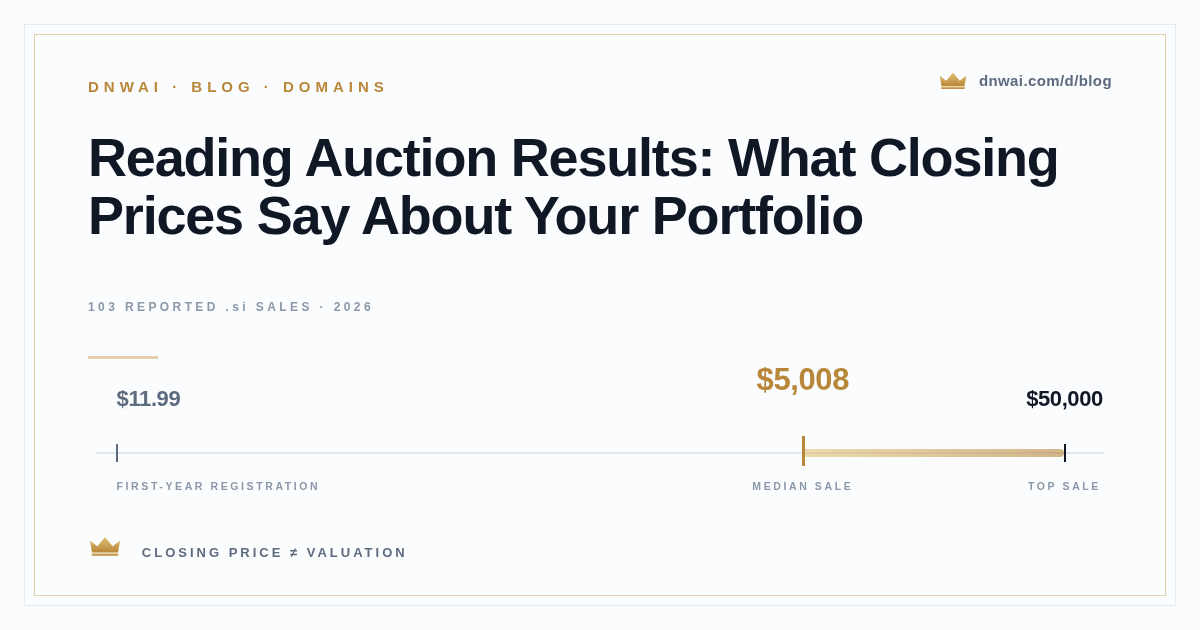
Start with the shape of the .si market, because it is small enough to see whole. Our tracked dataset for 2026 shows 103 reported retail sales, against 29 in the fourteen years before. The median is $5,008. 59 sales cleared at $5,000 or more, and 21 were five-figure.
That distribution matters more than any single result. The headline of the month was staffing.si at $50,000 — almost exactly ten times the median. Read the median and the ceiling together and the market resolves into two rooms: a small room where dictionary words clear at five figures, and a larger room where the rest of the names clear somewhere near $5,000 or not at all.
Under both rooms sits a registration layer. 89,938 .si names were registered in twelve days in October, at a first-year price around $11.99. The median sale is roughly 418 times that registration price. That gap is the entire business of aftermarket pricing, and it is also why a single close cannot be applied to a name that costs $12 to replace.
Lesson one: before you read the number, read the room.
Pass one — classify the close
Every auction result belongs to a format, and format sets the price band more than the name does.
- Reserve auction. Atom runs 5-to-7-day events where the reserve is hidden from bidders and the name stays unsold if the floor is not met. You learn what the top bid was, not what the market would have paid.
- No-reserve auction. Wholesale liquidation events start at $50, carry no reserve, and drop $10 a day to a $10 floor if nobody bids. A close here is a liquidation price, not a retail price.
- Private sale. No venue, no competition, no public comp. Useful as a data point, weakest as evidence.
- Retail marketplace sale. Sedo carries most of the .si volume, with Spaceship, Atom and fruits.co behind it, followed by private deals.
A $50 liquidation close and a $5,008 Sedo median are not a hundred times apart because one seller was foolish. They are different products sold to different buyers under different clocks. Comparing them is how people talk themselves into bad prices in both directions.
Pass two — normalise to net, never gross
The number that belongs in your pricing sheet is what reaches your account after the venue, the renewal and the clock. Three deductions do most of the damage:
- Commission. Atom's ladder runs 7.5% / 15% / 30-to-15%; Afternic's grid runs 30 / 25 / 20 / 15% with a $15 floor; Sedo's split runs 10 / 15 / 20%; Atom auctions carry a 10% commission. A $5,008 close at 20% is $4,006.
- Renewal already paid. A name carried for two years before it sold has cost two renewals, and those come out of the proceeds before the sale is a profit.
- Time and exclusivity. An Atom auction requires nameservers pointed at Atom for the full event, and any NS change removes the name from the auction. A 7-day auction is 7 days in which the name cannot be sold anywhere else.
Run the same filter on the small end. A $50 no-reserve close nets $45 after commission. On our shelf, where the average renewal is about $12 a name per year, that is under four name-years of carry — for a name you have permanently priced at $50. The floor is not a strategy; it is an exit.
Pass three — compare against your own book
This is where most portfolio owners go wrong: they compare a close to the ceiling of its extension instead of to their own inventory.
The top twelve .si sales of 2026 sum to $298,602, with a median of $20,000 — four times the market median. Every one of those names is a short dictionary word in a commercial category: staffing, gifts, hollywood, bot, travelagent, build. They are not a random sample of .si. They are the reason the sample looks expensive.
Our own .si names are priced at $199 (Chauffeurs.si) and $1,795 (GetLogo.si). Against a $5,008 median those are 4% and 36%. Two possible readings, and only one of them is right:
- The names are underpriced relative to the extension, and we should raise them.
- The names are different products — a French occupation word and an English brandable — and the median is being set by dictionary words we do not own.
We chose the second reading, because the top twelve tell us what a dictionary word does in a retail auction, not what a two-word brandable does. Had we raised both to the median we would have moved our asks twenty-five times on the strength of twelve names we do not hold.
The same discipline applies on the .com side. Thirteen of our .com names carry a median ask of $375 against a median appraisal of $1,999. The appraisal is a comparable-set estimate; the ask is what we believe clears in a market where those same names produced one human reply across 41 emails and 33 contact forms in twelve days. Neither number is the truth. The gap between them is the negotiation range, and it is a range we chose deliberately.
The result that is not a number
An unsold reserve auction still produces data. There is no close, but there is a top bid and a gap between that bid and your floor — and that gap is the market making a counteroffer in public.
We read the gap in three bands. A top bid above 60% of the reserve means the format worked and the floor was slightly high; lower the reserve and rerun the same name in the next event. A top bid between 40% and 60% means the name has a market but not at your price; keep the listing and cut the floor on the next attempt. Below 40%, the reserve is not the problem — the name's band is wrong, and no amount of rerunning will close it.
Bid shape matters too. Atom sizes increments by price band and runs proxy bidding, so a long bid history at the bottom of the ladder says nothing about where the top bidder's maximum sits. Two bidders walking $10 at a time to $300 is a weak result dressed as activity. One bidder who entered once and stayed is a private sale with a public price. Count the bidders, not the bids.
The number worth adding to your sheet: realization ratio
One derived figure has done more for our pricing than any appraisal: close ÷ ask. Not for the market as a whole — for names you actually listed, or names close enough to yours that you would have listed them at the same price.
Four buckets:
- Under 25%. Your ask was fiction. The close is telling you the name's real band, and the next listing should start within 20% of it.
- 25–60%. Normal negotiation. Nothing to change; this is where most domain deals live.
- 60–100%. Priced right. Hold the number and keep the listing where it is.
- Over 100%. Underpriced, or the buyer had a specific use. Do not reprice the whole shelf on one strategic buyer.
The ratio only works if you record three things next to every close: venue, format and date. A 40% ratio at a liquidation auction is a good outcome; the same 40% at a Sedo retail sale is a pricing failure. Same number, opposite conclusion.
What we changed after reading October
Three changes, all small, all in the pricing sheet rather than on the site:
- A comp-weight column. One close in a band counts half. Two closes count one. We only move an ask after three comparable closes, or after 90 days of no inquiry at the current price.
- A net-proceeds line. Every listing now carries its expected net after commission at its own venue, not just the gross ask. On a $488 median ask that is $451 after Atom's 7.5%, and one such sale covers the annual renewal on roughly 37 of our 177 priced names.
- A 90-day clock per name. Two inquiries and no offer means the price is not the problem — the category is. Zero inquiries at an ask above three times the wholesale comp means the ask is the problem, and we cut to two times the comp rather than wait another quarter.
We did not raise the .si names to the median. We did not cut the .com median to the appraisal. We added a rule that makes both decisions mechanical the next time an auction closes.
The one-sentence version
A closing price is a sentence about one buyer; a portfolio needs a paragraph. Read the format, net the proceeds, compare only against names you could have listed at the same price — and let three closes, not one headline, move the number on your shelf.
Buying a name this week?
180 exact-match, brandable and geo domains — buy-now price, escrow-protected, same-day transfer. See the portfolio · the contact page