
From Portfolio to Product: Packaging Domains as Investor Lots
2026-11-02 · Investor lots, portfolio, packaging
Selling forty names one at a time is forty negotiations; selling them as four lots is four products with a price, a story and a buyer profile. How to build the units, what a lot buyer actually evaluates, the document pack that removes his fear, and the lots we will not assemble.
Most portfolios are sold the way they were built: one name at a time, one enquiry at a time, one price argued at a time. That works while the shelf is small. It stops working somewhere around a hundred names, when the same seller is answering the same questions about the same eight slow names and the numbers on the spreadsheet have not moved in eleven months.
The move that changes the arithmetic is not a bigger list and it is almost never a bigger discount. It is treating part of the portfolio as a product rather than as inventory: grouping names into units with a name, a price, a rationale and a defined buyer, and then selling the unit instead of the piece. A lot does not have to sell for more per name. It has to sell more often, to fewer people, with less of your time.
This is how we build them, what an investor-lot buyer actually evaluates before he bids, and the lots that are a bad product no matter how they are priced.
Why a lot is a different product, not a bigger listing
A single-name listing asks a buyer one question: do you want this name? Most of our individual names sit in a $199 to $1,795 band, and each one is worth a few minutes of a stranger's attention. The buyer who has a business to name answers yes or no in a paragraph and moves on.
A lot asks a different question: do you want this category? That question is answered by a different person. It is answered by someone who has already decided he wants to hold a small portfolio, and who is now choosing between your shelf of geo names and somebody else's shelf of two-word service names. He is not buying a name; he is buying a position in a category, from someone who did the curation he would otherwise do himself.
That has three consequences worth designing around.
- The buyer pool is smaller. Ten times fewer people want a category than want one good name — the first objection anyone raises, and a true one.
- Each conversation is worth more. Six conversations that would produce six $299 sales can produce one worth the same money with a quarter of the messaging.
- The lot advertises the singles. A published lot page is a category page: it ranks, it gets shared, and it puts coherent names in front of a buyer who then asks about the one he liked.
So the lot is not a discount channel. It is a second front door into the same shelf, and its main product is the buyer relationship.
The four units a portfolio actually has
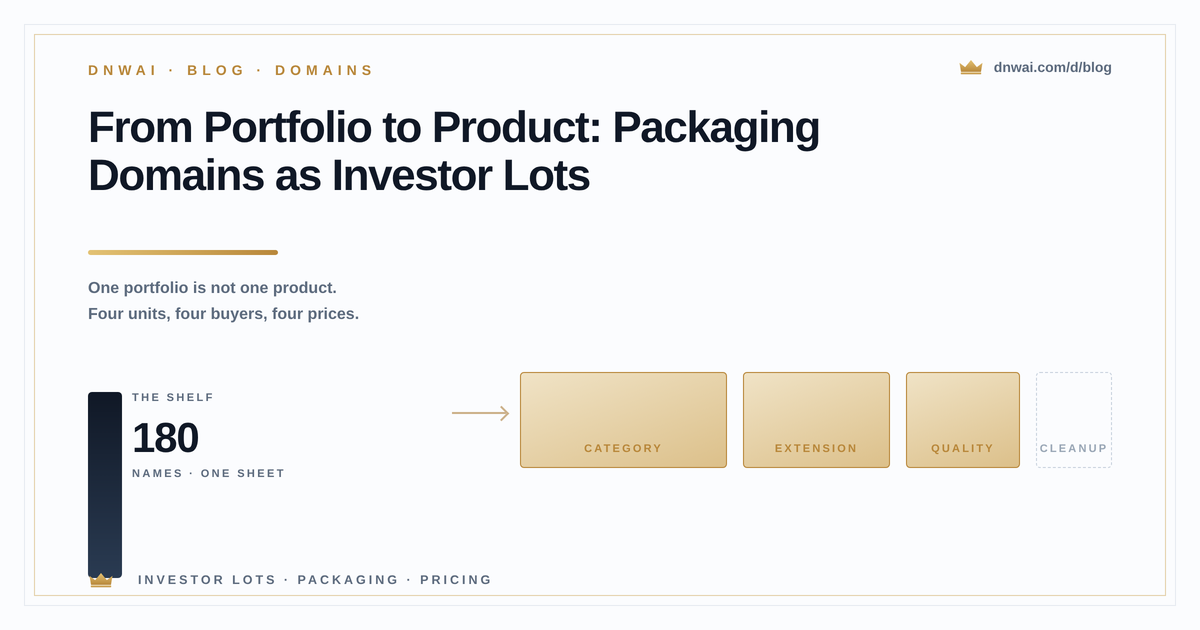
Before pricing anything, we sort the names into four groups, because each one becomes a different kind of lot and only two of the four are worth building.
- Category lots. Everything serving one trade or one place, held together. This is the strongest unit, because the rationale writes itself: a buyer who owns two plumbing names in one city understands immediately why a third and fourth belong next to them.
- Extension lots. One exact brand root across several extensions, or one root in .com plus a set of ccTLDs. These sell to a single buyer who protects a brand, and they sell slowly, but the rationale is absolute — split them and each piece loses most of its value.
- Quality-band lots. A wholesale tranche of everything priced at the bottom of the shelf, sold as inventory to another investor. This is a clearing product, and its only selling point is the price per unit.
- Cleanup lots. Names kept because of an old plan, with no buyer and no category. Wrapping twenty of these in a spreadsheet is not a product. It is a discount with paperwork, and it reads that way to the buyer within a minute.
If a group cannot be described in one sentence that a stranger would repeat to a colleague, it is a cleanup lot and should not be assembled. The test: can you name the lot without the word "and"? "Six German city chauffeur names" passes. "Six brandables and two geo names" fails.
What the lot buyer evaluates before he bids
An investor buying a lot runs a different checklist from a founder, and he runs it fast.
1. Unit consistency. He asks whether the names are interchangeable. If nine are two-word service names in one language and the tenth is a four-letter coined brandable, he discounts the whole lot, because his next sale is a different motion for that tenth name.
2. Renewal load against expected holding time. Every name in the lot ships with a renewal date and a renewal price, and he adds them up. He will hold most of the lot for longer than you did. A lot that carries $180 of annual renewals across ten names is easy to say yes to; the same lot at $420 needs a story before it needs a price.
3. The included-price ratio. Here is the part sellers get wrong. If a lot has three names with real sell-through potential and seven that are dead weight, the buyer pays for the three and charges you for the seven. Our own renewal note covers a shelf where a median ask near $488 sits next to a renewal bill above $2,000 a year across the priced names: the names that justify the bill are never the majority. A lot should look like the minority. Three strong names plus seven fillers is a discount; seven strong names plus three fillers is a product.
4. Transfer mechanics. Ten names is ten push-or-transfers, ten auth codes, ten registry quirks and in our case a set of .si names that move differently from .com. He is imagining doing that himself, badly, at 2 a.m. Every step you remove from that list is worth money to him.
5. The document pack. This is the difference between a lot that sells and a lot that gets a lowball. It should fit on one page per name and one page for the lot.
The document pack that removes the fear
The reason lots sit is rarely price. It is that the buyer cannot verify what he is buying, so he protects himself with a number low enough to survive being wrong. The pack makes him right.
- One table per lot: name, extension, registration date, registrar, expiry date, renewal price, current ask, and whether it has ever been listed before.
- One line of rationale per name: the trade, the city, the language, or the root it serves. Not adjectives.
- The lot sheet: total ask, the sum of the individual asks, the lot price, what changes if he takes the whole lot this week, and what he can add for a fixed extra.
- The closing mechanics: which registrar, whether we push or he transfers, who pays renewal in flight, which escrow the buyer prefers, and who pays the escrow fee. Put the answer down rather than asking the question — buyers name a fee as an objection when it is actually an unanswered line in a document.
- The honest note: one short paragraph on which two names in the lot we would keep if we were him, and why. It costs us nothing and it is the single thing that has ever turned a suspicious buyer into a fast one, because it proves the pack was written by the person who owns the names.
The work is formatting facts you already hold, and the return is three exchanges of negotiation you no longer have.
Pricing a lot without inventing a discount
The arithmetic of a lot starts from the sum of the individual asks, and then subtracts real costs rather than a round number.
- Transfer effort. Ten transfers is not free for the buyer. A fixed allowance per name is defensible and easy to explain.
- Renewal drag inside the term. If four names expire inside the next six months, the buyer is buying a bill. Either prepay those renewals before the sale, or subtract them explicitly — do not leave them to discovery.
- The weak names. Price them at what they are: wholesale or zero. A lot priced honestly at seven names sells faster than a lot priced at ten with three names nobody wanted.
- The convenience premium. Selling the unit saves you the curation and the messaging, and it saves the buyer the search. It is fair for the lot price to sit near the sum of the single asks and not far under it — the discount is paid in the transfer and renewal lines, not in the headline.
What we will not do is invent a lot price and call the individual asks "retail". Buyers know what the singles cost, because the singles sit on the same shelf. A lot price has to survive being compared to your own prices — so build it from them.
The lots that are a bad product
- A lot with no category, assembled to save the seller's listing fees.
- A lot priced above the sum of its parts, which a buyer verifies in one minute on your own pages.
- A lot whose lead name is mid-negotiation, because you have now made the lot a liability.
- A lot with an undisclosed renewal inside ninety days, which ends in a dispute after escrow rather than a conversation before it.
- A lot you would not buy yourself. This one is not a rule of thumb, it is the test: open the lot sheet, read the rationale, and ask your own buying question. If the answer is no, the buyer's answer will be no faster.
The honest summary
A lot is not a way to move names you could not sell. It is a way to sell a category to a buyer who never shops name by name. The work is curation — a unit that holds together, priced from its own singles, with transfer and renewal costs written down rather than discovered. Done that way, one lot conversation often produces what a month of single-name enquiries would have, and it leaves behind a category page that keeps finding buyers after the lot is gone.
Buying a name this week?
180 exact-match, brandable and geo domains — buy-now price, escrow-protected, same-day transfer. See the portfolio · the contact page