
Payment Plans: Converting Big BINs Into Down-Payment Sales
A $3,000 buy-now price is a wall for a buyer with a launch budget of $900. Instalment terms convert that wall into a funded escrow: the three numbers a plan is built from, what the commissions and escrow fees do to a split payment, and the terms we refuse to offer.
The most expensive names on a shelf are usually the easiest ones to price and the hardest ones to sell. A four-figure buy-now number is a defensible valuation, it is backed by comparable sales, and it sits there for a year without a single serious offer, because the people who want the name are founders, and founders in their first quarter do not have four figures of spare cash for a domain. An eight-month inquiry log with one question repeated — "can we pay in parts?" — is the usual evidence that the only thing standing between that name and a sale is the calendar.
That gap is what payment plans exist for. Not as a discount, and not as a favour, but as a way of selling the same name to the same buyer at the same total price across a schedule the buyer can survive.
The problem is that most sellers who try it build the plan from the buyer's side of the table — what the buyer can afford this month — instead of from theirs, and then discover at the end of the term that the plan paid less than a cash sale would have, took eight months, and carried risk they never priced. This is how we build one instead: the two numbers a plan is made of, what the fee structure does to a split payment, which buyers get terms, and the clauses we will not drop.
Why the cash price is not the plan price
A cash sale at $3,000 nets the seller $3,000 minus commission and minus whatever escrow costs. The money lands once, the name and the risk leave together, and the seller can reinvest the proceeds the same week.
A plan at $3,000 over twelve months nets less even though the headline is identical, and it is worth being explicit about why. The seller keeps the asset but loses the ability to sell it to anyone else. He carries the risk that the buyer stops paying in month four, and the recovery in that case is not a refund — the name is still his, but the months are gone. He also carries the small costs nobody invoices: renewal during the term, the record-keeping, the follow-up.
So the cash price is not the plan price. A plan should carry a premium that pays for the risk, the delay, and the lock. That premium is not a hidden fee; it belongs in the terms where the buyer can see it, because the buyer already knows he is asking for something a cash buyer is not.
In practice, our rule is that the total of a plan lands somewhere above the cash price and below the buyer's own mental ceiling — the number he would have paid if he had the money this month. When the plan total exceeds that ceiling, the buyer stops believing he got a deal and starts feeling he is being charged for being poor. When it lands under the cash price, the seller has simply financed a discount.
The three numbers a plan is built from
Every plan we have written reduces to two numbers, and both have to be set deliberately.
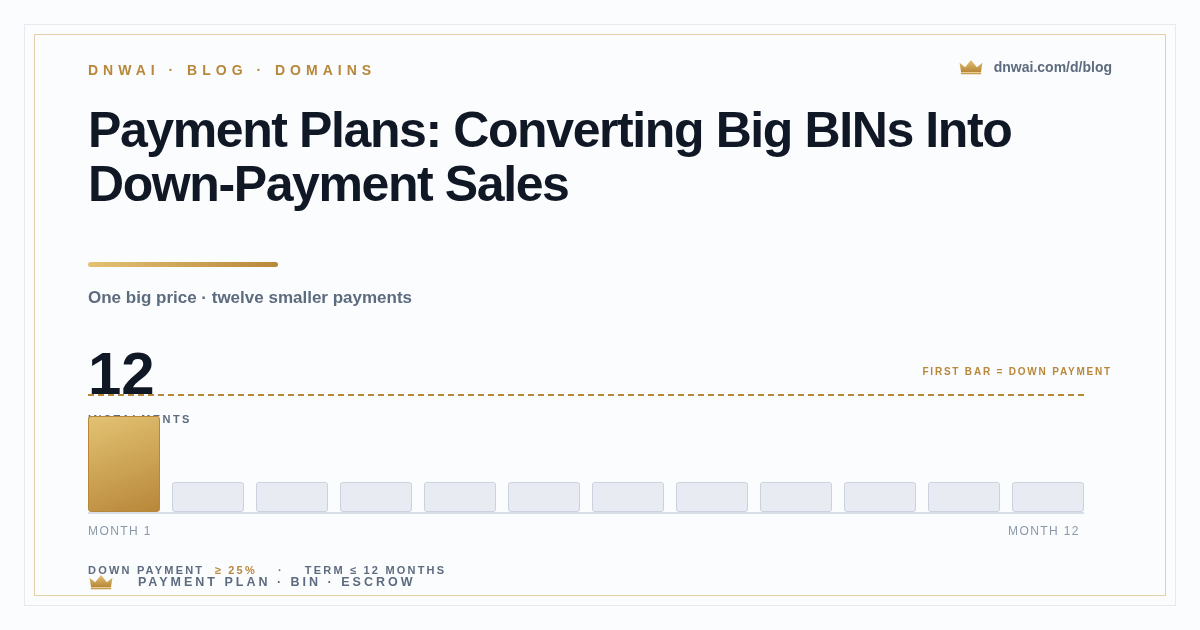
The term. Twelve months is the default because it matches a fiscal year and a budget cycle. Six months is common for four-figure names and safer for the seller. Twenty-four months does not exist for us at any price: the risk compounds faster than the premium, and a name tied up for two years is worth less than the price it was sold at.
The monthly instalment. It is a remainder, not a choice — the total minus the down payment, divided by the remaining months — so the only thing that is actually being negotiated is the total and the length. Setting the instalment first and working backwards is how plans end up at a total that makes no sense.
Write those three numbers down before the first conversation, and the negotiation stays short. What we will not do is negotiate the three numbers independently: a buyer who wants a lower down payment is asking for a longer term or a higher total, and framing it that way ends the argument faster than any explanation of risk.
What commission and escrow do to a split payment
The fee structure is where instalment plans quietly lose money, and it is worth working through one example with real numbers instead of adjectives.
Take a $3,000 name. A 7.5% commission on the sale is $225, so a cash sale nets $2,775 before escrow. On a plan, the same percentage is applied to each instalment as it clears, so the commission total is the same $225 if the splits add up to $3,000 — the platform takes its cut of what it processes, not of the headline. That part is neutral.
Escrow is not neutral. A transaction fee is charged per transaction, and a plan can create twelve of them instead of one. If each instalment is run through a per-transaction structure with a floor, the total cost of collecting $3,000 in twelve pieces can be materially higher than collecting it once — and the seller discovers this at the end of the year, not the beginning.
If the plan total is higher than the cash price, that difference is collected outside the marketplace record — an arrangement between two parties — so the arithmetic has to be done on net proceeds per payment, not on headline totals. The practical version: add up every fee you will actually pay across the term, compare it to the fee you would pay once, and add that difference to the total as a visible line. A buyer who understands that a twelve-month plan costs more to administer accepts the number. A buyer who is handed a total with no explanation assumes he is being overcharged and starts negotiating against the whole thing.
Which buyers get terms, and which do not
A payment plan is a tool for a specific buyer: someone with a live project, a business that exists, revenue or funding, and a launch date inside the term. Those buyers pay, because the domain is on their critical path and stopping the payments stops their project.
The buyers who do not get terms are the ones with no business behind the interest. An investor who wants to spread risk across a portfolio is asking the seller to lend him money at no interest to hold an asset for resale; the answer is no, and it is a short conversation. A buyer with no site, no company and no timeline is a speculator with a plan, and the plan is not worth financing.
Three questions sort them quickly. What is the name for? When does it go live? Who pays the invoices? If the answers are concrete, the plan is plausible. If the answers are vague, the plan is a way of holding the name without paying for it.
We also set one rule that is not negotiable: the name does not transfer until the final payment clears. A buyer who needs the name in his registrar on day one for an SSL certificate or a mail domain can be argued with, but the answer stays the same — the risk of transferring first and collecting later is concentrated entirely on the seller, and no premium compensates for it. What we offer instead is a written agreement that names the transfer date, and a notice period that lets the buyer plan around it.
The default clause nobody reads until it matters
Most payment-plan disputes are not about the price. They are about what happens when the payments stop, and that question is answered by whatever the parties wrote down — or did not.
Our terms are short and they are all enforceable:
- Payments made before a default are not refundable. They are rent on a name the buyer used for the period he paid for.
- After two missed instalments the agreement terminates, the buyer's right to the name ends, and the seller is free to sell it again.
- Any amount already paid is credited against a future purchase of the same name by the same buyer, for twelve months, at the total originally agreed. That last clause costs nothing when nobody uses it and ends most arguments when somebody does.
- Renewal during the term is paid by the seller and is not added to the total. It is already in the premium.
That set of clauses is deliberately boring. The point is not to punish a buyer who hits a bad quarter; it is to make the seller's position unambiguous before the first payment, so that a default is a procedure rather than a negotiation.
When a plan is the right answer, and when it is not
A payment plan converts a big BIN into a sale when three things are true: the buyer has a real project, the price is the only obstacle, and the seller can afford to keep the name off the market for the term.
It is the wrong answer when the seller needs the cash now — a plan delays money, it does not raise it. It is the wrong answer when the buyer's only qualification is enthusiasm. And it is the wrong answer when the name is one the seller expects to reprice upward in the next twelve months, because a fixed total locks out that increase for the length of the agreement.
The last point deserves its own sentence: a plan is a price commitment, not just a payment schedule. If the comparable market moves while the term runs, the seller is on the old price until the last instalment, and the buyer knows it.
The honest summary
A payment plan is the only mechanism on a domain shelf that turns a good name and a poor quarter into an actual transaction. It is not generosity, and it is not a discount — it is a price for patience, paid by the buyer and charged by the seller.
Build the plan from two deliberate numbers, make the buying decision visible by setting the down payment high enough that the buyer has skin in it, price the fees you will actually incur across the term instead of pretending the total is the same as a cash sale, and write the default clause before anyone signs anything.
Do that, and the four-figure name that sat unsold for a year becomes a sale with a start date. Skip it, and the same name becomes a twelve-month conversation with a buyer who pays three instalments and disappears, which is the most expensive outcome of all.
Buying a name this week?
180 exact-match, brandable and geo domains — buy-now price, escrow-protected, same-day transfer. See the portfolio · the contact page