
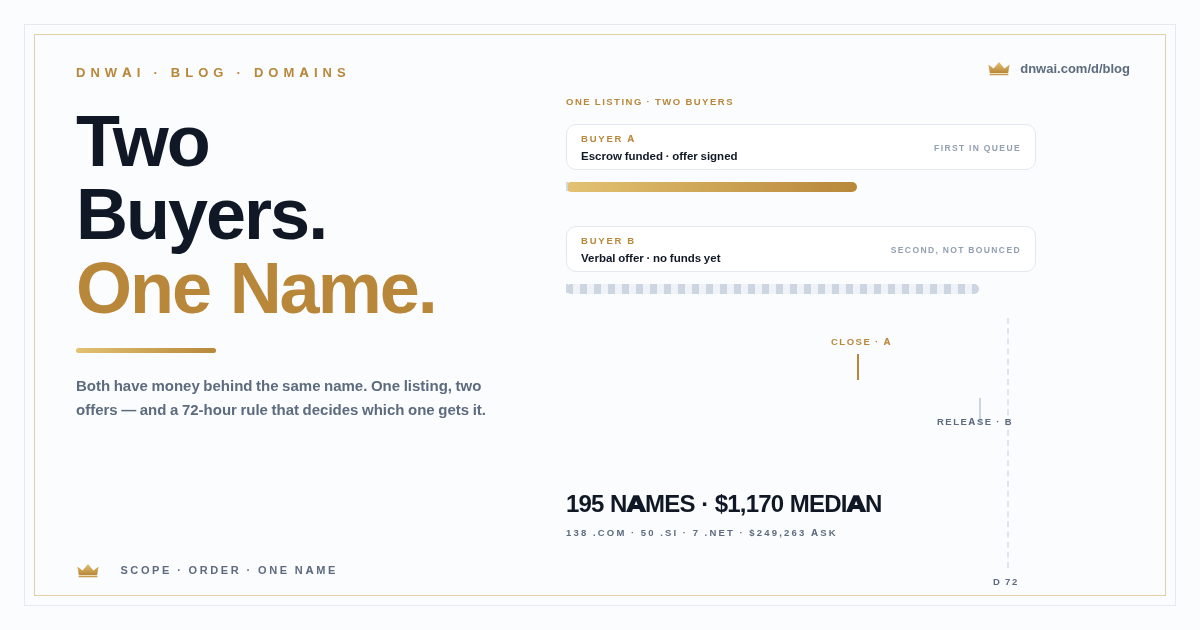
Two Buyers, One Name: Running a Parallel Negotiation Without Losing Both
Two buyers on one name is not a good problem. It is the moment a listing stops being passive and becomes a small negotiation with a hard clock, two people who each believe they are the chosen one, and a seller who cannot say yes twice. Most of the regret in this business comes from that moment, not from pricing.
I have run it a handful of times at this point, and I have run it badly exactly once: two interested buyers, both told they were "the front-runner," one of them funded, and a paralysing wait for the cheaper offer to improve. The cheaper offer never improved. The funded buyer got tired, escrow was refunded, and the name went back to a fifth month of silence. The lesson cost a sale and took about an hour to fully understand: the second buyer is not leverage if the first buyer is only guessing.
What follows is the version I run now on a shelf of 195 names, 138 .com, 50 .si and 7 .net, a total ask of $249,263 and a $1,170 median. Those are the numbers the live listing page reports, and they matter only as a reminder of the scale: at 195 names, two offers on the same name happen a few times a year, and each one is a chance to get paid or to lose the only buyer you had.
The mistake that looks smart and is not
The tempting play is to tell buyer B that another party is interested. It creates urgency, it is invisible, and it is verifiable only in the abstract. The problem is that it is a claim you then have to support. The moment B asks "who?" or "how much?", you are either disclosing things you have no right to disclose or visibly backing away from your own leverage.
The safer variant is to say the name is in an active process, which is true, and to say nothing else. Real urgency comes from what B can observe: the name's listing status, the fact that you answered within an hour, and the deadline you put in writing. Invented competition is a one-time bluff with a compounding cost, because a buyer who discovers a bluff tells the next five buyers.
The rule I use is narrower than most advice you will read: I never state that another offer exists unless it does, and I never state its size. What I do state is my own decision order, out loud, to both sides.
The decision order, written down before either reply arrives
Before I answer either buyer, I write four lines on the same sheet that holds the price:
- What closes cleanly first. A funded escrow at 62% of ask beats a verbal offer at 90% of ask until the money moves. I have watched a $1,750 verbal offer evaporate three days running while a $1,200 escrow sat funded and waiting.
- The floor. The price below which I would rather keep the name and pay the renewal. For a .com costing $12–$22 to renew, my floor is a genuine number almost every time. For a heavy-ask brandable, the floor has to include what I would net after commission, not what the buyer pays.
- The window. Seventy-two hours from the moment I confirm receipt of an offer, in writing, with the deadline stated as a date and a time rather than "soon."
- The one move that ends it. If the funded party's deadline passes and the second party has nothing funded, the name stays with whoever had the money. No extension offered, no discount invented to restart a cooling conversation.
Those four lines decide 80% of the awkward messages before I have to compose them. They are written before the first reply because a seller improvising under time pressure always makes the same mistake: he tells both parties a little more than he should, and the story stops matching.
What each buyer is told, and what is never said
The two buyers do not get the same message, and they do not get either other's story. What they get is the same structure:
- Status: the name is available today at its published price, and there is an active process on it.
- The mechanics: the route is escrow, the transfer is a push rather than a 60-day registrar move where possible, and the buyer pays the escrow fee on their side unless we agreed otherwise.
- The deadline: a date and hour, stated once. Not repeated in every follow-up, which reads as pressure and signals the deadline is soft.
- The scope: exactly what is included — the name, the registrant change, nothing else. If a buyer believes archival content or a logo is part of the deal, that is a conversation that should have happened before funding.
What never gets said: the other buyer's price, the other buyer's category, the other buyer's identity, or any estimate of how likely the other party is to close. The first three are obvious. The fourth is the one sellers leak by accident, with phrases like "I have someone very serious." Serious is not a status a seller can certify.
Where the 72-hour rule comes from
The 72-hour window is not industry law, and I am not presenting it as one. It is a calibration that fits the two gears that decide a domain sale: how quickly escrow can be funded, and how long a buyer's interest survives a competing demand on their attention. A funded escrow at a marketplace typically moves within days rather than weeks; a verbal offer from an individual founder has a half-life measured in hours, not days.
Seventy-two hours is long enough to let a funded buyer complete a signature and a payment, short enough that the second buyer does not disappear into a "let me think about it" that ends in silence. Longer windows do not improve offers. In the replies I have read across 2,097 sent emails, persuasion almost never came from a third message chaser — it came from the price and the name being right when the reader was ready.
One discipline that matters more than the number: the window starts when the offer is confirmed in writing, not when it is expressed verbally. A verbal "I'm interested at 1,200" is a mood. A written offer with the name, the amount and the route is a decision. Starting a clock on a mood guarantees the clock runs out.
When the first buyer withdraws after the second is committed
This is the failure mode worth planning for, because it is not rare. The sequence: buyer A is in escrow, buyer B is told there is a process and asked whether to be kept as a backup. A then walks — a budget freeze, a partner disagreement, a bad quarter. B is still there but has now been waiting and has learned the price had been accepted at a level they were told not to beat.
Two choices. The first is to go back to B at the same price, honestly, and explain that the first deal did not complete. B will assume a problem, and some proportion of Bs will now negotiate harder because the name has a visible failure attached. That is a real cost, and refusing to pay it is how names sit unsold for a year.
The second is to put the name back at list price and restart the process, taking the loss on the calendar rather than the price. I use this when the withdrawal happened inside A's 72 hours and B has not yet been told anything specific. If B was told a process was running and then told nothing for two weeks, the first option is the only honest one left.
The version that never works is asking B to match A's fund — usually because A's fund was preferred. If equal money is the answer, the earlier process had nothing to do with the decision and both buyers are entitled to know that.
What this looks like on a 195-name shelf
At portfolio scale the problem changes shape. On a single name, two buyers are a negotiation. Across 195 names the risk is that the same name shows up twice in different channels at different prices, which turns a parallel negotiation into a public inconsistency. That is why the shelf data is kept in one place and prices are read from the listing page rather than from memory.
The price distribution matters here: 55 names ask under $500, 27 sit between $500 and $999, 82 between $1,000 and $1,999, and 31 ask $2,000 or more. The median .com is $940 and the median .si is $1,999. Two offers arriving on the same name is a small-number event, but a name in the $1,000–$1,999 band is the one where the offers most often arrive at nearly the same moment — precisely because that is the band where a serious small buyer and an opportunistic reseller both feel at home — and the one spot where two half-committed parties can cancel each other out.
The part sellers find hardest
Nothing about running two buyers well is clever. It is a decision order written down in advance, one deadline stated once, and a refusal to invent competition to speed up a slow reply. The hard part is temperament: the second buyer looks like safety while the first buyer looks like risk, and every instinct says to keep both warm with vagueness. Vagueness is what loses both.
A clear no from a buyer who has stopped answering is worth more than a warm maybe from a buyer who never funds. The name is an asset with a renewal date attached; the calendar is the thing being spent. Whoever can convert that calendar into cleared money, in the band the name deserves, is the buyer — and the faster a seller can say so out loud, the fewer deals they lose to their own patience.
Buying a name this week?
193 exact-match, brandable and geo domains — buy-now price, escrow-protected, same-day transfer. See the portfolio · the contact page