
Landers, Lead Capture, and the AtomPay Route
We run three kinds of lander across 180 names, and until this month none of them captured an email address we owned. That single sentence is the whole problem with domain landing pages.
Check it yourself. Chauffeurs.si, priced at $199, resolves to a Spaceship "domain for sale" page with a Buy Now button and a Make Offer field. GetLogo.si, priced at $1,795, resolves to Atom's landing page at /lpd/name/getlogo.si. Our portfolio page at dnwai.com/d lists all 180 names with prices. Three doors, three designs, and in all three cases the only thing that survives a visitor who does not buy is a line in someone else's analytics.
Here is what we changed, and why the AtomPay route made it affordable.
A lander is a decision page, not a brochure
A buyer who types a domain into the address bar already knows the name. They are not looking for a brand story or a paragraph about the extension. They are asking three questions, in this order, and they answer all three in about eight seconds:
- Is this actually for sale? Not "may be available" — for sale, by a person, at a number.
- What does it cost, and is the number firm? A hidden price reads as "expensive and negotiable", the worst of both signals.
- What happens if I click? Buy now, make an offer, or talk to someone. One primary action.
Everything else is decoration. We have seen landers with a contact form, a phone number, a chat widget and a newsletter box, and the buyer still left because none of those four was the price.
The landers that convert are boring: name, price, one button, one line of proof. Proof can be a short line about the portfolio — 180 names, same seller, instant transfer — because the real objection on a one-page lander is not the price. It is whether a stranger behind a parking page will hand over the name once the money moves.
Four sources reach a lander, and each needs a different first screen
Traffic arrives through four doors, and they behave nothing alike:
- Type-in. Someone guessed or half-remembered the name and expected a website. They need the price in the first screen and nothing else.
- Marketplace referral. The buyer clicked through from Atom, Sedo or Spaceship having already seen the price and the trust badges. The lander only has to not lose them.
- Exact-name search. Someone searched the phrase, not the domain. Highest-intent traffic we get, and the only traffic that rewards a paragraph of relevant text.
- Outbound click. Somebody we emailed opened the link. They are mid-conversation, and the lander is a receipt that must confirm the price and the person who wrote to them.
One page cannot serve all four. We serve three: a type-in lander with price and Buy Now, a marketplace template we do not control, and the portfolio page for anyone we send there ourselves.
Our own outbound shows how little a click is worth on its own: across 41 emails and 33 contact forms in twelve days we produced one human reply. Earlier in the year, 100 cold candidates narrowed to 57 addresses without a newsletter, then 23 replies that were actually replies, then two human conversations — one asking to be removed, one offering $50 against a $295 ask. A click is not a lead. A conversation is a lead.
Capture the offer, not the newsletter
Nobody wants a domain newsletter. What a visitor to a lander will give you is one of three things, and each is an offer in disguise:
- An offer below your ask. They want the name at a number you will not take today. That is an interested buyer with a budget, and the most valuable data point you can collect.
- A payment-plan request. They want the name but not the lump sum. A lead asking about terms has already accepted the price.
- A "tell me if the price changes" request. Weakest of the three, but it costs one field and it converts when you eventually cut the price.
The form that collects these is two fields: email, and a number or a sentence. No name, no company, no phone. Every extra field costs you the second and third category, and those are the categories that turn into money later.
Two rules matter more than the form design. Write the lead down somewhere you own — if the marketplace holds it, you lose the buyer who walks, and a buyer who offers $50 against $295 today is a buyer at $200 in four months. Reply within one working day, from a person, with the price in the message.
The arithmetic of a lead, on stated assumptions
The model is ours, with assumptions to replace: take a name listed at $488 — the median ask across our 177 priced names — and assume 1,000 lander visits a month, a 2% enquiry rate and a 10% close on enquiries. That is 20 enquiries and two sales, roughly $976 gross and $902 net of Atom's 7.5% standard listing rate.
Now move one variable. Raise the enquiry rate to 4% with a visible price and a single button and the same traffic produces twice the sales. Move the close rate instead — by answering in a day with a real number — and you get the same lift. Move neither, add traffic, and you must double visits to move a single percentage point.
But the cheapest variable is neither of those. It is the fee at the end.
The AtomPay route: 1.35% to 4.5%
Atom publishes one ladder for listings and a separate rate for its payment product. AtomPay runs 1.35% to 4.5% based on selling price, with 4.5% standard on premium domain transactions and 2.25% for Atom Edge members. Against that: a standard listing at 7.5%, Plus at 15%, and the Premium band that takes 30% at $4,998 and below, 25% from $4,999 to $49,999, 20% up to $74,999 and 15% above. Atom also states a $100 minimum for retail transactions and points sellers below it to the Wholesale Marketplace.
The same two names at four routes:
- Chauffeurs.si at $199. AtomPay at 4.5% nets $190.04. Standard listing at 7.5% nets $184.08. Plus at 15% nets $169.15. Premium in the 30% band nets $139.30.
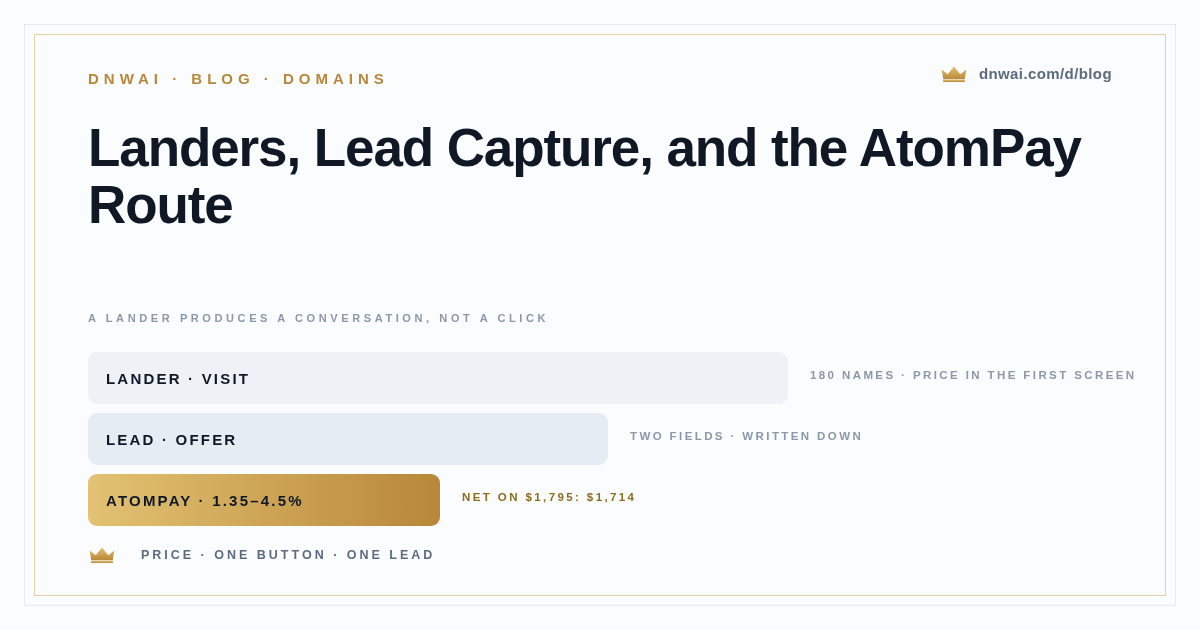
- GetLogo.si at $1,795. AtomPay nets $1,714.22 at 4.5%, $1,754.61 at 2.25%, $1,770.77 at 1.35%. Standard listing nets $1,660.38. Plus nets $1,525.75, the same as Afternic's 15% band. Premium in the 30% band nets $1,256.50.
The gap between the cheapest and most expensive route on the $1,795 name is $514 — on a name whose annual renewal is about $12. The fee is not a cost of doing business; it is the difference between one route paying for 149 renewals and another paying for 104.
Atom also runs a Custom Checkout Link for deals you close yourself: 5% on Buy Now and 10% on lease-to-own, with a $15 minimum. AtomPay is cheaper on a straight sale, the checkout link is cheaper on terms, so the product you reach for depends on whether the buyer pays once or monthly.
One honest floor: at a $100 minimum, the twelve names on our shelf priced at $100 are not AtomPay candidates. They are wholesale inventory, and pretending otherwise means a checkout that costs more in overhead than the sale nets.
What the cheap checkout actually buys you
A 1.35–4.5% fee does not just improve the net on a sale. It changes which sales are worth running.
At a 30% commission a $199 sale nets $139, and you need volume to make the funnel worth maintaining. At 4.5% the same sale nets $190, close enough to the gross that a lander with a Buy Now button becomes the sensible default for the small end of the shelf. The commission stops taxing exactly the segment that is hardest to sell.
It changes the lead strategy too. At 30% you need the venue's traffic to justify the fee, and the venue keeps the buyer relationship. At 4.5% you can afford to own the conversation: reply from your own address, send a checkout link, and keep the buyer on your list for the next name.
The handoff is where deals die
The gap between "buyer said yes" and "money arrived" is the part nobody designs. Ours, as it stands:
- A human reply with the price and the link, within one working day.
- A checkout link in the same thread, so the buyer can pay without creating an account on a marketplace they have never heard of.
- A written transfer timeline — who initiates, what the buyer receives, when. Most abandonment here is not price resistance; it is a buyer who cannot picture the next 24 hours.
- One follow-up at 48 hours, then stop. Two messages after a verbal yes is persistence. Five is why people stop answering domain emails.
Our commonest failure is not the buyer disappearing but the offer arriving in a channel with no record — a WhatsApp message, a phone call, a marketplace chat we do not export — so price, terms and timeline are renegotiated from memory. Every lead gets a line in a file: date, name, offer, next action. That file is the actual asset.
What we are changing this quarter
Four changes, all additive, none a redesign:
- A price and one button in the first screen of every lander we control. No hidden numbers.
- A two-field capture on the portfolio page — email and an offer — written to our own file, not a marketplace dashboard.
- AtomPay as the default route below $5,000, with the 2.25% Edge rate checked before each sale and the Custom Checkout Link reserved for lease-to-own.
- A 24-hour reply clock with a named owner, because a lead answered on day three is a lead answered by a competitor.
We are not moving 180 names onto a single lander. The marketplace templates carry trust badges we cannot manufacture on a one-page site, and pulling names off them would cost more in traffic than it returns. The change is narrower: keep the venue's traffic, own the lead, and pay 4.5% instead of 30% whenever the buyer is already in conversation with us.
The one-sentence version
A lander's job is to produce a conversation, not a click; a lead is worth more than a visit and worth nothing if you do not write it down; and at 1.35–4.5% the checkout stops being the tax that decides whether the small end of your portfolio is worth selling at all.
Buying a name this week?
180 exact-match, brandable and geo domains — buy-now price, escrow-protected, same-day transfer. See the portfolio · the contact page