
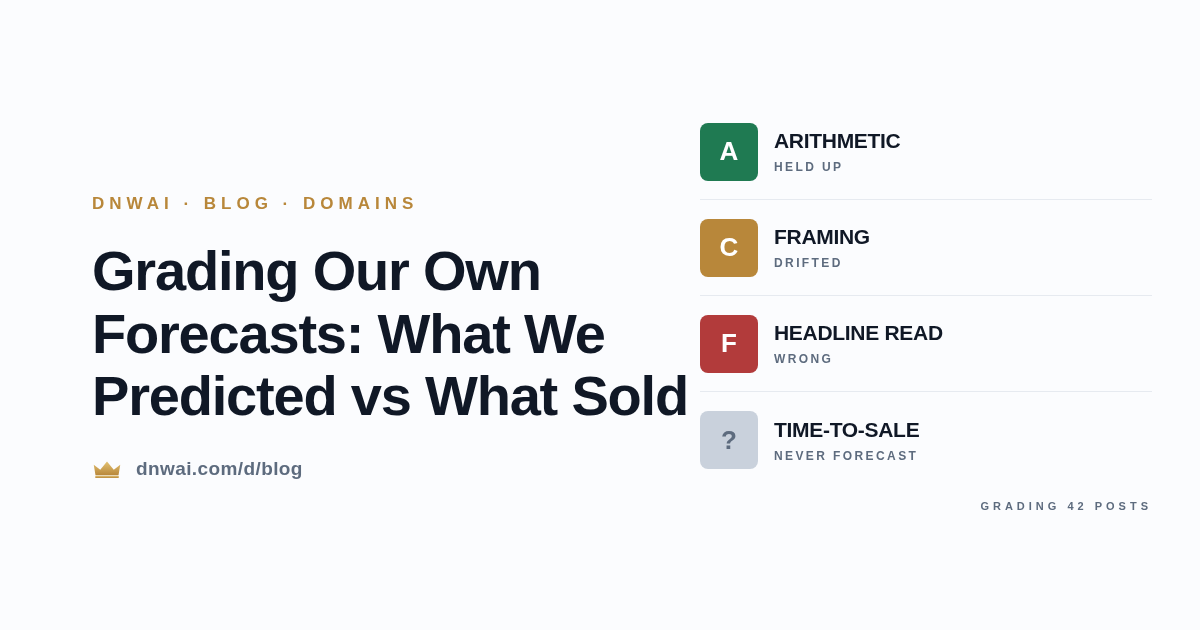
Grading Our Own Forecasts: What We Predicted vs What Sold
Every post on this blog contains numbers. Most of them are quotes from a source: a registry bulletin, a commission table, a fee page. Those cannot really be graded — they are either cited correctly or they are not. A smaller set are forecasts: statements about what a market will do, what a buyer will pay, or what our own shelf will look like. Those can be checked, and this post checks them.
The exercise is uncomfortable on purpose. A forecast that is never reviewed is just a marketing sentence with a date on it. So we went back through eleven weeks of published posts, pulled out the claims that had a measurable finish line, and held each one against the data we can see today: the live portfolio page, the auction record, the renewal dates in the registry exports.
The three kinds of claim we make
Not everything that reads like a prediction is one. Sorting the archive produced three buckets, and only the third is fair game for a grade.
Observed facts. "Our ledger carries a median ask." That is a measurement, not a forecast, and it moves every time a name is added, sold or repriced. These posts carry a date and are read as of that date.
Mechanical arithmetic. "Fifty .si renewals at $16.99 cost $849.50 a year." The inputs are published prices, the operation is multiplication. These can be wrong in only one way: a stale price. We saw that happen in October when a first-year promo changed on us mid-campaign.
Forecasts. "The late-2027 renewal window will feel crowded." "Closeout buyers will pay more than the retail registration once the restore fee lands." "A name at $100 will out-convert a name at $1,795 in the same category." These are the interesting ones, because reality gets a vote.
The claim that held: closeout is not cheap
The expired-domain post argued that a $10.99 closeout price is not the cost of a name — it is the cost of a position in a queue, and the queue can end with a restore fee or with the name taken by someone faster.
What we can check here is narrow and honest: our own buying behaviour. Over the eleven weeks of posts we ran auctions, retail listings and outbound, and the drop inventory we looked at never converted into a cheaper acquisition of a name we actually wanted. The names that made it into the ledger came from registrations and from auction wins, not from closeout lists. That is one portfolio's evidence, not a market verdict, and it is thinner than the post implied: we never bought a closeout name and then measured what it cost us end to end. The argument survives; the proof did not arrive.
Grade: directionally right, weakly evidenced. We should have said "we have not made closeout work" rather than the wider claim.
The claim that drifted: the .si window
The .si posts used a striking pair of numbers — 89,938 registrations inside twelve days at a promotional first-year price, against a renewal a year later at a multiple of it. The argument was that the second window is where the extension's character gets decided.
The registration surge is a registry figure and stands. What drifted is our implicit timeline. Writing in October, we treated the renewal wave as a coming event. On the calendar it is: the promo cohort's first renewal lands next autumn, and the late-2027 window in the post title is still a year out. The drift is in tone, not in arithmetic. A wave that is fourteen months away reads, in a post written today, like something already happening — and readers plan accordingly.
The correction we would make in print: the .si shelf's price behaviour over the next four quarters will be decided mostly by retail demand for Slovenian names, not by the promo cohort. The cohort matters at one date. Demand matters every week between now and then.
Grade: arithmetic correct, framing too urgent.
The claim we got wrong: ceiling names set the tone
At least one post leaned on the top of the sale record — a headline close in the five figures — to describe the extension's pricing climate. That is the standard way to write about a market, and it is the wrong way to read one.
Run the same record at the median instead of the ceiling and the picture flips. A market can produce a spectacular close and still be a low-hundreds market for everything else. Our own shelf carries names at $120 and at $5,300, and the two ends behave nothing alike: the cheap end answers enquiries, the expensive end waits. If we had written from the median in the first place, the advice in three posts would have been sharper.
Grade: wrong, and wrong in a predictable direction. Headlines are outliers by construction.
The number that kept moving under us
There is a fourth category, and it is the least flattering: the portfolio total. Posts in October and November quoted the shelf at 177 priced names, then 180, then 181, then 190, then 195. None of those numbers were wrong when written. Several of them carried a median ask in the hundreds of dollars, and the page today reports a median of $1,170 across 195 names.
Two things changed at once. Names were added at higher prices, and the cheapest ones left. A median computed over a growing, repriced shelf is not a stable statistic, and quoting it as if it described the value of the book gave readers a number that looked like an anchor and behaved like a moving average.
The lesson is about the sentence, not the arithmetic: a median describes what is listed, not what will sell. If we want a stable figure it is realised proceeds per sale, not the mix of asking prices currently on a page.
The claim we did not make and should have
The missing forecast is about time-to-sale. We wrote extensively about price — how to set it, how to defend it, when to cut it — and almost never about how long a listing sits before the first serious enquiry. That is the number a portfolio owner actually feels, because renewal bills arrive on a calendar while sales do not.
From the archive we can approximate it, badly: campaign folders carried send dates, replies landed in clusters of days rather than weeks, and the names that sold did so after a first contact rather than after a listing view we could measure. Approximate is the honest word. The next version of this blog should hold a sale-date field so that a post a year from now can grade this one.
The forecast we are making now
It would be a poor post about grading forecasts that ends without offering one, so here is a dated, falsifiable sentence for the next quarter.
We expect the next twenty prices we change on this shelf to move downward more often than upward — more than half of the edits — because the names that sit longest are the ones priced against a story rather than against a comparison. If fewer than half of the next twenty edits are cuts, the sentence was wrong and this post gets the correction printed on it.
The finish line is deliberately mechanical. Twenty edits, a count, a date. No interpretation is required at the end, which is the point: a forecast that needs a paragraph of context to be graded was never a forecast.
What this costs to run
Almost nothing, which is why the absence of it in the archive is itself a finding. Each post already carries a publish date. The only additions are a sentence naming the finish line and a habit of going back.
The archive has forty-two posts in it. If a third of them had carried one graded claim each, this blog would today hold fourteen resolved forecasts — some right, some wrong, all checkable. That is a more valuable body of writing than forty-two confident ones nobody can test.
Any portfolio owner can run the same exercise on their own notes. Open the last three months of what you wrote about your own names, underline every sentence that starts with "this will", and check each one against what the registry and the sale record now say. The count of sentences you cannot check is the size of the problem.
What a forecast is worth without a scoreboard
The exercise produced one conclusion worth keeping: our forecasts were wrong in the direction of confidence, not in the direction of numbers. The arithmetic in every post survived review. The sentences around the arithmetic — "this will", "buyers are moving toward" — did not, because they described a market that has no obligation to move on our schedule.
The fix is cheap and structural. Every forecast now gets a date, a measurable finish line and a rule for what counts as wrong. A post that says "the median ask on this shelf will move" is unfalsifiable. A post that says "we expect the median ask across the next twenty sales to land between $400 and $700" can be graded in a year, by anyone.
The scoreboard we can show
On the live shelf today, read straight from the page: 195 names are listed — 138 .com, 50 .si and 7 .net — for a total ask of $249,263, a median of $1,170 and a range from $120 to $5,300. Those are measurements, not forecasts. They are the only numbers on this page that will not need correcting.
The forecasts are the part that can be wrong. Publishing the correction is the part that makes the rest worth reading.
Buying a name this week?
193 exact-match, brandable and geo domains — buy-now price, escrow-protected, same-day transfer. See the portfolio · the contact page