
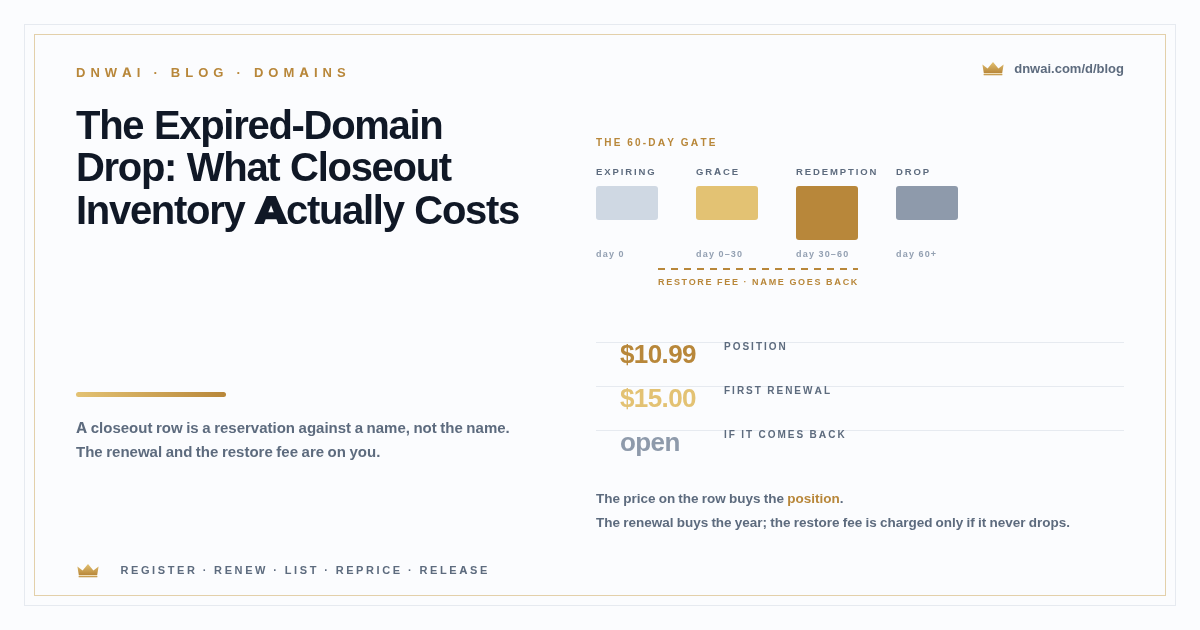
The Expired-Domain Drop: What Closeout Inventory Actually Costs
A domain drops because nobody renewed it. That sounds like the cheapest inventory in the business — the registry releases the name and whoever wants it pays a registration fee. The cheap part is real. What is not cheap is the invoice after the drop, and the uncertainty between the drop and the day the name is actually yours.
This is not a guide to catching drops at speed. Catching at millisecond level is a different trade, needing backorder capacity and a budget that assumes most catches fail. This is the arithmetic a portfolio holder needs before putting a name from a closeout list in the cart: what the price covers, what it leaves behind, and how to turn it into a maximum buy price.
What "closeout" is actually selling
Closeout inventory is not a domain. It is a reservation against a domain that will, at some point in the next window, become registrable again. Between the previous registrant stopping payment and the name becoming free, the registry runs the sequence defined by ICANN's Expired Registration Recovery Policy: renewal notices before and after the expiry date, then a redemption period in which the previous registrant can reclaim the name by paying a restore fee on top of the renewal.
For a buyer the sequence is a sequence, not a switch: every day of it you do not control the nameservers, cannot publish a site, cannot send mail, and cannot tell a client the name is theirs. A closeout purchase buys a position in that queue, not an asset.
That distinction is the entire cost model. A $10.99 closeout against a $12.99 registration looks like a $2 saving — until the name arrives eleven days late with a restore fee attached because the previous owner changed their mind halfway through.
The four numbers on a drop list
Drop lists are written to be scanned, not trusted. Four numbers matter, and three are usually missing from the row.
The closeout price. What you pay the platform for the position. It is usually tied to the day of the window, not the value of the name: the same name can be $10.99 on day one and $79 on day four. That is not a market signal, it is a clock.
The restore fee. If the previous registrant comes back inside the redemption window, the name does not drop. The registry charges a restore fee, and the operator that holds your closeout order passes that cost to you. Restore fees are quoted per registry and per TLD, typically an order of magnitude above a registration. A platform that omits it from the row is telling you when you will find out.
The drop date. Not the closeout date: the date the name is expected to return to the pool, which is the expiry date plus the registry's grace and redemption periods. This decides whether the purchase is useful at all. A $10.99 name arriving in three weeks is dearer than a $349 buy-now that transfers in an hour, if you need it this week.
The renewal that will be yours. Every dropped name arrives with a fresh one-year term charged at the registry's price, not the closeout price. The closeout buys the position; the renewal buys the year. A maximum-buy calculation that forgets it is short by exactly the next invoice.
The gateway: what happens in the thirty days after
The window between expiry and availability is where the real expense lives. A name in that window is not abandoned; the previous registrant owns it until a specific date, with a reclaim path active for most of it.
Three things can happen to a closeout order in that window:
- The name drops and you get it. The best case, and it is not the default. It is the case where the previous registrant stayed gone.
- The name is restored. The previous registrant pays the restore fee and keeps the name for another term; your order is refunded or credited, and your cost is the wasted days plus any deposit.
- The name is renewed at the last minute. The same outcome, with less warning.
None of these is a scandal; it is the mechanism working. A list where twenty percent come back is not broken — its closeout price just has to be discounted by the probability the name never arrives.
So never plan a launch, a client handover or a sending domain around a name that has not dropped yet: the date is an expectation, not a commitment. If a project needs a domain by Friday, buy one that exists today and pay retail. The closeout saving is small next to a launch that slips two weeks.
Why the names on the list are priced the way they are
A very low closeout price is a composition signal, not a bargain. Names that reach the final stage survived a backorder auction without a bid, then a multi-day closeout window without a buyer, then a final discount step without a buyer. The sequence filters for one trait: nobody wanted the name at even a wholesale price.
That does not make the names worthless — a brandable nobody wants today can be right for a buyer who does not exist yet — but the filtering matters when two hundred rows contain twenty that look like a steal: a market with more information already declined them higher up. Buying them needs a thesis about a specific buyer, not a feeling that the discount is large.
The inverse holds too: rows above the registration fee have a real backorder history, and there you compete with people who run this as a business. No drop makes a wanted name cost $10.99.
The maximum buy price, written down
Every purchase decision here collapses into one number: the most you should pay for a name today. For a closeout order that is not the price on the list; it comes from what the name has to earn.
The formula, in order:
- Start from the wholesale exit. If the name cannot be resold tomorrow to another investor, what will a marketplace bid give? That, not the AI appraisal, is the floor of the range.
- Subtract the holding cost for the term you expect. Closeout price, first renewal, every renewal you plan to pay, plus processing and commission on the exit. On a $100 name held three years at $15, that is $100 + $45 + commission, not $100.
- Multiply by the probability the name actually arrives. The one factor a retail buy-now does not have. A twenty percent restore chance means the effective price is the closeout price divided by 0.8, and the wait is longer than the drop date.
- Compare with the cheapest name today that does the same job. This step kills most closeout decisions. If a comparable brandable sits in a marketplace at $195 with instant transfer, a $79 closeout landing in three weeks is not cheaper — it is dearer, with more risk.
Whatever the formula produces is a ceiling, not a target: it lets forty rows be scanned in ten minutes, and the survivors are the only ones worth a second look. The number that does not belong in it is the AI appraisal, which reads the string and not the queue position.
What I check before pulling from a closeout list
The checks run in this order because each is cheaper than the next.
The expiry date and the drop date, side by side. If a platform shows only one, assume the earlier one is the closeout date. The gap between them is the cost of the position, measured in days.
The renewal price at the registry that will hold the name. A dropped name arrives at the catching registrar's renewal rate, not the discount price you saw. Some TLDs make the name a liability from day one, whatever the closeout price.
The history. A dropped name can carry a past: check the Wayback Machine for the previous use and search the name for a business still trading under it. A name freed from a live business is a name with a live trademark risk.
The outbound position. Who would I email about this name tomorrow, and would they recognise it? If nobody, the closeout price does not matter: the name sits in the renewal calendar costing money every year, the quiet failure mode of cheap inventory.
The arrival date against the calendar. Anything for a launch, a campaign or a client is checked against the drop date first. If the use sits inside the window, the name is declined regardless of price.
A worked example with my own ledger
My own shelf makes it concrete, because retail and closeout decisions sit on the same calendar. The export holds 181 names — 140 .com, 34 .si, 7 .net — with a median ask of $495 and $153,008 in total asking prices. Thirty-eight expire within forty-five days (35 in November, 9 in December), and the cheapest twenty in that window run from $100 to about $200. Those are not closeout purchases; they are names I already own and must decide on.
The logic is the same. A $100 name with a $15 renewal is $145 by year three before commission; if the wholesale exit is a $50 auction bid, the name has to sell at retail more than once every few years to break even. That is the arithmetic that decides whether a $79 closeout row is a bargain or a subscription.
The closeout list changes only the first term: the acquisition line moves from $349 to $10.99 or $195 to $79. The renewal, commission and probability lines do not move. A buyer who has run the arithmetic on their own portfolio needs no new model for drops — only one more factor: the chance the name never comes.
Where closeout inventory is genuinely the right purchase
One case makes the closeout clearly the better route: a name bought for the name itself, a brandable with no deadline, no client, no launch attached. The position cost is then nearly irrelevant and the only question is whether the name belongs on the shelf. A $10.99 order landing in three weeks and costing one renewal beats any marketplace listing for the same string, because nothing is waiting on it.
That is a small share of purchases, and it is the share to buy from closeouts. Everything with a date on it belongs in the retail market, where the premium buys the one thing closeout inventory cannot sell: certainty that the name is yours today.
A drop list is not a shortcut to cheap inventory. It is a market in time, and the price on the row is the first instalment only.
Buying a name this week?
193 exact-match, brandable and geo domains — buy-now price, escrow-protected, same-day transfer. See the portfolio · the contact page