
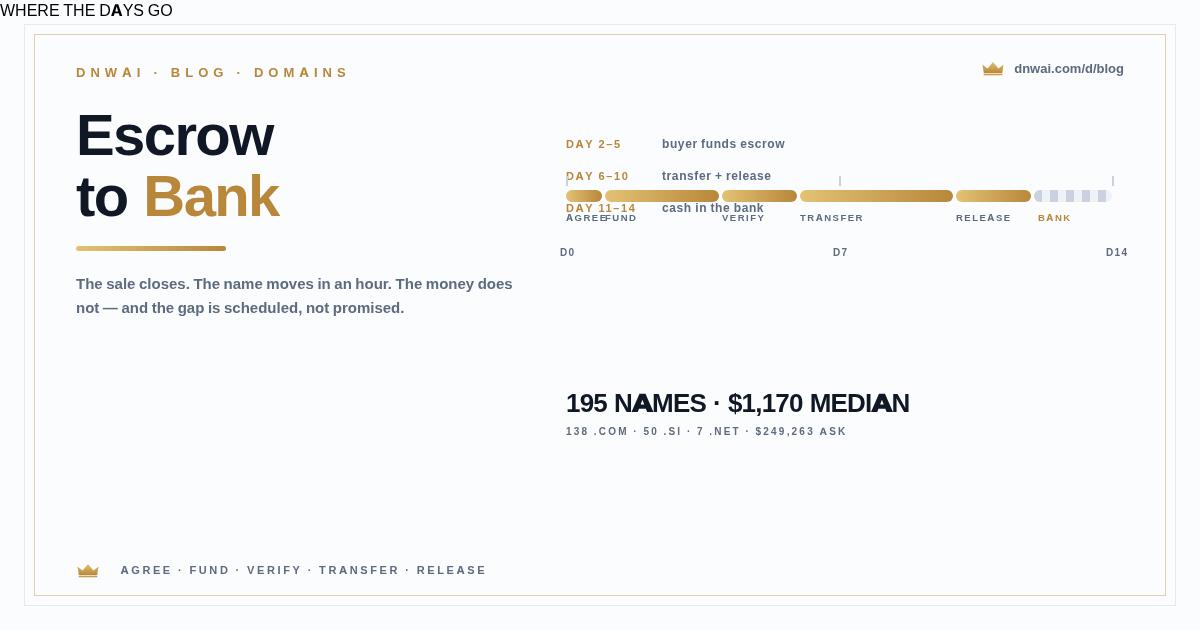
Escrow to Bank: The Real Timeline of a Domain Sale Payout
A buyer agrees to pay $2,400 for a name. The escrow account opens the same afternoon, the buyer funds it within two days, and both sides expect the money to move. It moves eleven days later. Nothing went wrong. No one was dishonest, no policy was violated, and nobody needed to be chased. The delay was built into the process from the start, and neither party had mapped it before they shook hands on a number.
I have paid for and been paid for domains in this market for long enough to know that the payout timeline is the part of a sale nobody negotiates and everybody is surprised by. Price gets argued over for a week. The calendar gets accepted on faith. Then a seller who planned a purchase against that money discovers the gap the day the wire does not arrive.
This post is a timeline, not a promise. It is written from the escrow side of the table, with the same portfolio I write about every week behind it: 195 names on the live shelf today, 138 .com, 50 .si and 7 .net, a total ask of $249,263, a median of $1,170 and a range from $120 to $5,300. Those numbers are read off the listing page, not estimated. The point of quoting them is scale: at this size a sale is a routine event, and a routine event deserves a routine timeline.
Where the days actually go
The mistake most sellers make is treating escrow as a payment processor. It is not. Escrow is a custody arrangement with a checklist, and every step on the checklist can hold the transaction open.
There are five stages between "yes" and "money in an account I control," and each one has its own clock:
- Agreement to funded escrow. The buyer creates the transaction, the terms get written down, and the buyer pays in. Two to five days is normal, and weekends eat them unevenly.
- Verification. Escrow reviews the parties. For a buyer with a track record this is same-day. For a new company, a foreign entity, or an account whose registered address does not match anything official, this is the step that turns three days into ten.
- Transfer initiation. The seller unlocks the domain and delivers the auth code, or the two parties run an intra-registrar push. This step is fast in principle and slow in practice whenever the seller's account was not ready.
- The registry move. An inter-registrar transfer runs on the registry's schedule, not yours. The buyer must approve, or the transfer completes on its own if they do nothing.
- Release. Escrow confirms the name landed at the buyer's registrar, then releases. This is where the last quiet days live: approval of release, then a payment to a bank, then that bank's own settlement.
Each stage is small. Together they are a working week at the fast end and three at the slow end. On a $2,400 sale, that is a month of a name sitting in limbo — which is fine, as long as nobody's plan assumed the money was available on day four.
The two places money stops that nobody names in advance
The first is verification, not transfer. Sellers watch the transfer because that is the visible part. But the funding step is where the escrow company actually asks questions, and a mismatched corporate name on a wire is a real event, not a rare one. If the buyer pays from a company account with a slightly different legal name than the paperwork, the transaction pauses for a document request nobody expected.
The second is the day of the week, not the day of the deal. A release approved on a Thursday evening does not become cash on Friday. It becomes a payment instruction on Friday, a bank credit on Monday or Tuesday, and a settlement that a foreign seller may wait on longer still. That is not a fee. It is a calendar.
I have seen sellers argue price for six days and then lose a week to a Thursday-night release with no argument at all.
What the portfolio numbers say about cash-flow timing
Here is why this matters more than it sounds like it should. The median name on this shelf asks $1,170, and 82 of the 195 names sit between $1,000 and $1,999. That is the biggest band on the shelf by count. Fifty-five names ask under $500, 27 sit between $500 and $999, and 31 ask $2,000 or more.
So the typical transaction here is a four-figure sale that a seller has mentally spent before it lands. And a four-figure sale has a very particular shape: the amount is too small to justify a broker, too large to shrug off, and almost always earmarked for the next purchase. When the next purchase is another domain, the payout delay does not just cost patience. It costs a listing.
A seller who closes a $940 .com (the median .com on the shelf) on the first of the month and expects to spend that money on a new name on the fifth is going to miss the name. The .si side of this shelf has a higher median at $1,999, but exactly the same calendar.
The honest answer to "how long"
Anyone who quotes you a fixed number of days for a domain payout is describing their best case. What I will give instead is the shape of the delay and the three places it concentrates:
- Funding: two to five days, worst case ten when the buyer's bank asks questions about a new payee.
- Verification: same-day for an established buyer, one to two weeks for a new entity or a mismatched wire.
- Transfer and release: fast on a push, slower on an inter-registrar move.
Multiply the slow version of all three and a sale can take a month. Run all three fast and it can close in a week. Both are normal. The difference is almost never the escrow company — it is how prepared the two parties were before they said yes.
How I prepare a sale so the timeline is short
None of this is clever, and all of it is skipped under the pressure of a live negotiation:
- Agree on the escrow provider before agreeing on the price. Provider choice is the cheapest negotiation in the deal and the one that runs smoothest before a number exists.
- Sort the paperwork while the buyer funds. If the seller is a company, the registered name, the address and the bank beneficiary should match each other exactly before an invoice is ever issued.
- Unlock and prepare the auth code before the buyer pays in. A seller who waits for funds to arrive before unlocking the domain has added the funding window to the transfer window for no reason.
- Tell the buyer the release timeline in writing. One sentence: the name moves today, escrow releases after the registrar confirms, the bank credit follows.
- Never plan a purchase against a pending payout. Treat incoming escrow as money that does not exist until it is in the account, and a delayed release becomes an inconvenience instead of a missed opportunity.
The last one is the discipline that separates a portfolio that compounds from one that stalls. A shelf of 195 names produces sales often enough that the pipeline cannot be modelled on best-case timing. It has to be modelled on the median case, which is roughly a week and a half to two weeks from agreement to bank credit.
The two fees that show up at the end
The payout is not the price. Escrow charges the transaction, the marketplace may charge a commission if the sale came through a listing, and the receiving bank may take a cut on an international wire. On a four-figure sale those charges are material — they are typically the difference between a deal that made sense on paper and one that did not.
Which is worth saying plainly: if the sale is $300 and the escrow fee and the wire fee together are a meaningful fraction of it, the escrow route may be the wrong route for that particular name. A $120 .net on this shelf, bought by someone in the next city, can be closed by a registrar push and a bank transfer without an escrow company at all. Scale the process to the price.
What this changes about my own listings
Nothing about the asking prices, and a good deal about the expectations. A listing page that says "same-day transfer" is telling the buyer about the name, not about their money. The name can move in an hour. The cash takes longer, and pretending otherwise is how a smooth transaction ends with two people annoyed at each other.
So the sentence I would put on every listing, if it fit, is this: the domain moves quickly, the payout follows the registry and the bank, and both are scheduled rather than promised.
A domain sale is two transactions wearing one contract — the asset and the cash — and they never finish on the same day. Sellers who know that price the delay in from the start. Sellers who do not spend the week after a sale explaining why the money has not arrived to a buyer who already owns the name.
Buying a name this week?
193 exact-match, brandable and geo domains — buy-now price, escrow-protected, same-day transfer. See the portfolio · the contact page