
Email Deliverability for Domainers: What Actually Landed in Inboxes
Sixty property managers in Perth, one mailbox, four touches of a $199 domain offer: what the campaign data shows about landed mail versus sent mail, why an email verifier that answers 429 is not a clean list, and the four readings we trust more than any inbox screenshot.
2026-11-03 · Email deliverability, outreach, campaigns
Sixty property managers in Perth, one mailbox, four touches of a $199 domain offer: what the campaign data shows about landed mail versus sent mail, why an email verifier that answers 429 is not a clean list, and the four readings we trust more than any inbox screenshot.
Every domainer who runs outreach believes their mail lands. It is the one claim in this business that is almost never tested, because the test is invisible: you see what you sent, you do not see what was delivered, and the gap between the two is exactly where a campaign dies without a single error message.
We have been running a real campaign for two weeks — sixty property management firms in Perth, one Gmail mailbox, one name, four touches — and this week we went looking for evidence instead of impressions. Not "did I send it", but "what can I actually prove about where it went". The honest answer is less than we assumed, and the parts we can prove changed how the next batch is scheduled.
This is what our own numbers say about landed mail, why a validator that returns errors is not a clean list, and the four readings we now trust more than a screenshot of an inbox.
What the campaign actually sent, and what came back
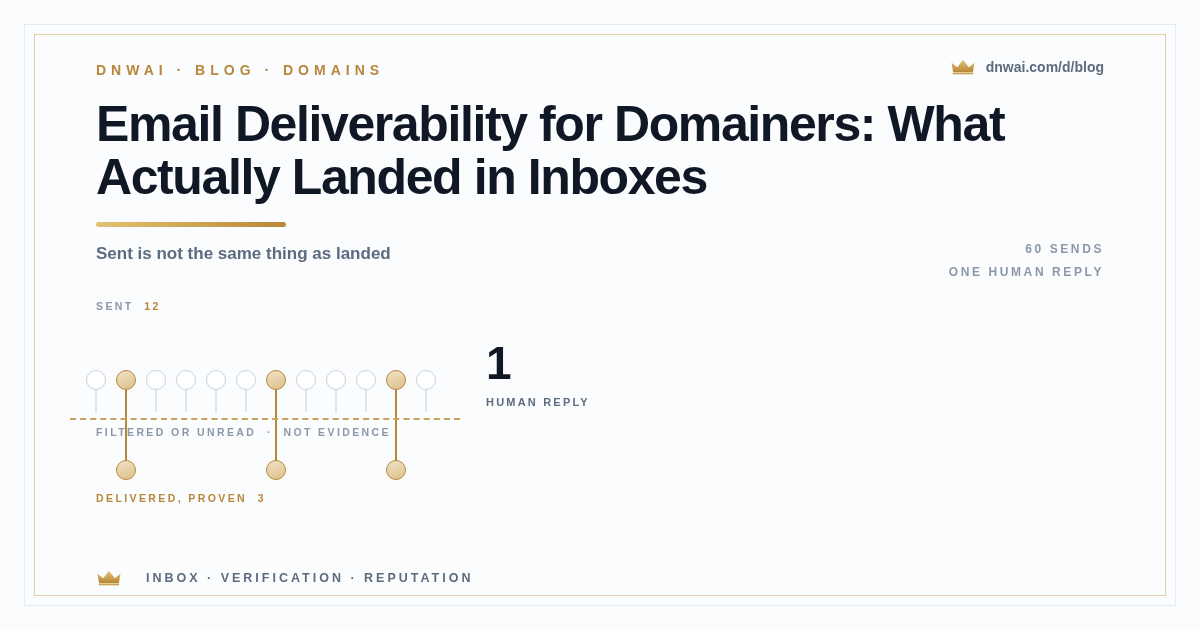
The setup is deliberately modest: a single sender, one of our Gmail sending mailboxes from Group A, writing to businesses that already operate under a name adjacent to HomesPerth.com. The offer is a $199 buy-now on a name that matches their market. Touch one went to all sixty prospects. Touch two has gone to eleven of them. One human reply has come back — and it was a marketing pitch aimed at us, not a question about the domain.
Those are the facts. Everything else people quote about deliverability comes from somewhere else: a vendor dashboard, a blog post about cold email tools, or a general impression that "Gmail usually delivers". None of those are evidence about this campaign.
What that leaves us with is a rule we now apply to every number in this article and every number in our own reporting: a message that produced no reply is not evidence of delivery, and a message that produced a bounce is not evidence of failure elsewhere. They are separate events with separate causes, and mixing them is how people conclude that a deliverability problem exists when the real problem is that nobody wanted the name.
The verifier that answered 429 for 144 addresses
Before the first touch we ran the prospect list through an email verifier. The result file has one honest thing to say: 144 addresses, 144 of them recorded as error, and every single error is the same string — HTTP Error 429: Too Many Requests.
That is not a validation result. That is a rate limit. What happened is that 144 addresses went through a free verification endpoint faster than the endpoint would answer, so the service started refusing, and the script dutifully wrote "error" into the file. Nobody read it closely enough to notice the list was never actually checked. The campaign went out anyway, because the send path did not require a verification pass — it required a non-empty address.
Two lessons came out of that, and both are cheap to apply:
- A validator's output needs a status taxonomy, not a boolean. valid, invalid, risky, unknown and error are five different decisions. Collapsing them into "checked" is how a 429 becomes a clean list.
- Retry with backoff, and count what is left unchecked. If the verifier returns 429 on more than a handful of addresses, the pass failed. It did not find the addresses good; it found the service busy. The correct next action is to slow down and re-run, not to send.
The 116-name fresh list behind the campaign was assembled from Google Business Profile results, and the 105 we could confirm carried a website, a phone number and a physical address. That part was real work and it is worth more than the verification step was: a business that publishes a street address and answers a phone is a better signal of a live inbox than any API verdict.
Why an empty inbox is the least useful signal you have
Here is the trap in measuring deliverability from a campaign that gets almost no human replies. If six hundred messages go out and four people answer, you have no way to tell whether the other 596 were read and ignored or never arrived. Both stories fit the data perfectly.
That asymmetry is why we stopped treating "no reply" as a deliverability metric and started treating these four things as the readings that matter:
- Hard bounces, in absolute count and as a percentage. A bounce is the only negative delivery signal you get directly. Our bounce rule is 2% as a hard ceiling, and any single batch that produces a bounce rate above it gets halved before the next send.
- Complaints, if you can read them. For a Gmail sender, Postmaster Tools is the only place a complaint rate appears as a number rather than a guess. Reply rate cannot be substituted for it — a happy reply and a spam report arrive through the same door, and only one of them is a problem.
- Authentication results from the received headers of a test message. Not from the DNS panel. It is common for a domain to have records published that a sending path never uses, and the only proof is what the headers of a real message say.
- Reply species, not reply count. We already learned this the hard way in our reply audit: of a hundred inbound messages, two came from a human. The single reply this campaign produced belonged to the same family — an agency offering us a service. Counting it as engagement would be an error, and it is the exact error that makes a weak campaign look alive.
Four readings, and none of them requires guessing what happened in an inbox we cannot see.
Separating the sending path from the asset
The campaign decision underneath all of this has nothing to do with SPF. It is about which domain is doing the sending.
A sending domain that runs cold outreach is a domain that can be burned: complaints, blocklist entries, a reputation that survives long after the campaign ends. A portfolio domain is an asset someone may buy from you next month, and its reputation is part of what they are buying — buyer mail, transfer notifications, escrow threads all travel through it. Those two jobs deserve different domains.
So the split we use is simple. Prospecting goes out from a mailbox that is allowed to be expendable. The portfolio domain keeps its transactional mail, its buyer correspondence, and its clean reputation. If the prospecting mailbox gets throttled or filtered, the consequence is a bad week, not a damaged asset.
That also sets an honest ceiling on what this campaign is allowed to claim. Sixty messages through one Gmail mailbox is a test of the list and the message, not a deliverability laboratory. It cannot tell you how a dedicated sending infrastructure behaves at volume, because it never reached that volume.
The volume rule that is really a patience rule
The temptation after a quiet week is to send more. That instinct is the single most reliable way to convert a marginal reputation into a bad one.
Our rules are unambitious for a reason: start at ten to twenty a day per mailbox, roughly double week over week only while hard bounces stay under 2% and complaints are near zero, and halve the next batch after any complaint. One message per company, not per contact. And the moment a thread opens, the address leaves the campaign — a reply turns a cold send into a conversation, and conversations are not subject to batch rules.
What we are missing on that ladder is the discipline of the pause. Sixty sends on one day is already above a comfortable first-week rate if the mailbox has not been warmed, and warming is the step people skip because it produces no visible output for two weeks.
Warming is not a hack. It is the process of giving a mailbox a sending pattern that looks like a person's before you ask it to carry a campaign. A mailbox that has sent twenty messages in its life and then sends two hundred in an afternoon is not behaving like a person, and no server needs to know why.
What we are changing in the next batch
Concrete changes, in the order they will happen:
- No send without a completed verification pass. The 429 result is now a blocking condition. A list with unchecked addresses does not leave the queue.
- The 60-prospect batch is finished before a new list is built. Touch two, three and four for the existing prospects come first. A half-touched list is a worse use of a mailbox than a new one, and it keeps the sequence on the same sender, which is what makes a follow-up recognisable rather than suspicious.
- Bounce and complaint counts get logged per batch, not per campaign. A campaign-level rate hides the batch that actually failed.
- The human reply is recorded as the outcome it is. One reply from an agency selling us a service is not interest in the domain. It stays in the ledger as noise, and the next reporting cycle will not count it as traction.
None of these is exotic. They are the difference between running a campaign and believing in one.
The honest summary
Deliverability for a domain seller is not a technical feature you install. It is the accumulated record of whether the mail you send deserves an inbox, and most of that record is decided by things that have nothing to do with your email template: whether the address is real, whether the business was already operating under a name you own, whether you sent sixty messages on day one to a mailbox you had never warmed.
Our data this month is unglamorous. Sixty sends. One reply that was not interest. A verifier that returned errors for every address it was asked about. That is a weak campaign, and the useful thing about it is that every number is real — which means every problem is findable. A campaign with glowing metrics and no evidence behind them is the harder one to fix, because you do not know which of the numbers to stop believing.
Selling a name outside the campaign?
180 exact-match, brandable and geo domains — buy-now price, escrow-protected, same-day transfer. See the portfolio · the contact page
Buying a name this week?
180 exact-match, brandable and geo domains — buy-now price, escrow-protected, same-day transfer. See the portfolio · the contact page