
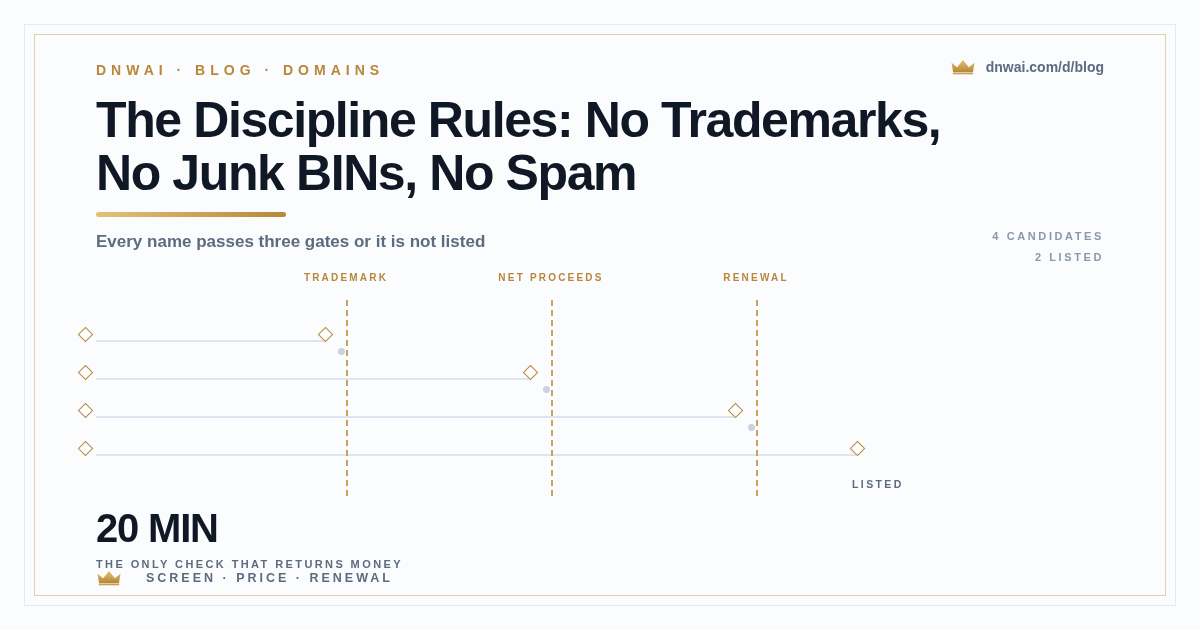
The Discipline Rules: No Trademarks, No Junk BINs, No Spam
Three of our own names, read line by line before they went public: the trademark screen that stopped two of them, the commission tiers that decide what a buy-now actually nets, and the renewal arithmetic that makes a cheap BIN expensive.
A portfolio does not rot in one dramatic way. It rots in three quiet ones: a name that is legally unusable gets listed because the check was never run, a buy-now is set low enough to look attractive in the grid and the commission then takes the attractive part back, and a ceiling widens until earlier pricing decisions stop meaning anything.
This is the list we now run before anything goes public, and these are three of our own names that were stopped by it.
The first rule: no trademarks, and the screen is twenty minutes
A domain is not a brand name you own. It is a string, and the string can already belong to someone in a class of goods you do not control. Two of the four stopped names failed this test, and both failed it in the boring way rather than the dramatic one.
The screen we run before any name goes up is deliberately short, because a long one never gets run: 1. Search the core word, not the whole string. "Shopuna" is checked as "shop" plus a coinage, and the coinage either returns nothing or it returns a company. The whole-string search always returns nothing useful, because nobody registers a domain as a trademark before they own it. 2. Search the Trademarkia and USPTO public search for the word in the class the buyer would sell in. A name registered in class 25 (clothing) is not a problem for a plumbing directory in class 42. A name registered in class 9 (software) is a problem for almost every buyer who would qualify, because almost all of them are launching software. 3. Check for an active business operating under the exact string. Not a parked page with the name on it — an operating company. This is the strongest signal in the whole screen and the cheapest to collect. 4. Check the common misspellings for live companies. A name that is a one-letter variant of a funded competitor is a legal argument waiting to happen, and the buyer will find out within a week of launch. 5. Write the outcome down. Which word, which class, which date, whatever the result. A screen you cannot prove you ran is a screen you will rerun in a different mood on a different day.
The one that stopped us was not a famous mark, which is what makes it instructive. The exact string matched an operating firm in another country, in the same class the buyer would use. No one would have sued us for listing it. But we could not write the sentence "you will be the only business operating under this name", and without that sentence the listing is just a string with a price.
The second stopped name was subtler: a coined word that overlapped a trademark family in a class most buyers of it would enter. Coined words feel safe. That feeling is worth nothing. What matters is who put the word in a class.
The second rule: no junk BINs
A junk buy-now is not a cheap name. It is a price that reads as a signal of low value, and the signal travels further than the price. Buyers browse a grid, and the grid teaches them what a priced shelf looks like. A $49 two-word .com next to a $1,795 brandable tells the buyer something true about the shelf's size and nothing at all about the names.
We now refuse three shapes of BIN: - A BIN below the first year of renewals plus the commission at the price. If a name is priced at $59, and the commission at that level is roughly $9, and the name has six or seven years of renewals behind it, the "sale" is a financing decision dressed as a sale. - A BIN that matches a competitor's price on a different class of name. This is how a shelf gets priced by other people's inventory. - A BIN set so low that the make-offer floor falls under the wholesale value. On our own shelf the make-offer floor sits at a median 61% of the buy-now. A $59 BIN implies a $36 floor, and a $36 floor is an invitation to a negotiator who will then ask for $20.
The number we actually want is the one that survives the commission and the renewal, not the one that looks smallest in a grid. When a $99 BIN nets roughly $90 after a marketplace commission at the entry rate, and the name has cost $12 to renew for five years, the sale paid for the name and honoured the time it took to sell it. Below that, the sale is a donation with paperwork.
The commission is a second price, and it is not constant
Most of us price against the buy-now and then feel surprised at the bank. The commission ladder changes the sale price the name must reach to net the number we actually wanted.
On Atom's published rates, a Standard listing is 7.5%, a Plus listing is 15%, and the Premium tier runs from 30% down to 15% as the price rises. On a $1,795 name the difference between a Standard and a Premium sale is $269.75 against $539.50 — an entire second sale's worth of money, spent to sit in a different shelf. We have written about that trade separately; the practical point here is that a name's commission tier is a pricing input, not a setting you pick once.
Two more costs sit underneath it: - The payment route. A marketplace checkout that runs through its own payment processor takes a smaller slice than a traditional marketplace sale — Atom's own published AtomPay rate is 1.35% to 4.5% depending on price band and method. On a $488 name the difference between 7.5% and 4.5% is $14.64. Small per name; not small across a shelf that sells forty names a year. - Escrow. A deal closed outside a marketplace still has an escrow fee at the buyer's end, and it appears in the conversation as a reason to discount. Know its floor before the buyer tells you.
The rule we adopted: compute net proceeds before the listing is published, and if the net proceeds are below what we would accept privately, the name is not ready to be published. Publishing first and discovering the net afterwards is how a shelf drifts downward one listing at a time.
Renewal is the third price, and it is the one that compounds
A BIN is a hope. A renewal is a bill. On a name that stays for five years at a $12–22 .com rate, the cost of holding is $60 to $110 before any sale happens — and at a $99 BIN with a marketplace commission, the name has to sell for the sale to have meant anything at all.
That arithmetic changes which names are worth holding at all. Three checks we run at renewal time: - The ask-to-renewal ratio. A name asked at $100 against a $22 renewal needs to sell every four to five years to pay for itself. A name asked at $1,795 against the same renewal needs to sell once in eighty years. The first number is not a business. - The listing cost of a cheap name. Every listing, every check, every touch spends time. A $100 sale that consumed four hours of work is a worse hourly rate than a $488 sale that consumed the same, and the shelf only gets so many hours. - The exit route. A name at the bottom of the shelf is exactly the name an investor lot buyer discounts. If it is not worth listing individually, it is inventory, and inventory has a market price. Moving it there is a decision, not a failure.
How it runs as a sequence
The rules only work because they are ordered. The steps we run for every name before it reaches a public page: 1. Trademark screen — five searches, written down, twenty minutes. 2. Buyers — who operates under the string today, and which class they are in. 3. Net proceeds at the intended BIN, at every commission tier the name could be listed under. 4. Renewal cost against the ask, and against the expected holding time. 5. Ceiling check — does this price change what the shelf says about itself. 6. Write the listing copy last, because the copy is the output of the five steps above, not a substitute for them.
Three of our own names are the working examples. One failed the trademark screen the boring way — an operating company in another country, in the class our buyer would use. One failed the net-proceeds calculation: at the BIN we had set, the commission tier plus the renewal history left less than we would have accepted privately. One failed the cheap-BIN rule at the other end, with a price that would have taught the shelf what the floor is.
None of the three was a bad name. Each was a name that could not be defended in one sentence, and a listing that cannot be defended in one sentence is a listing you will eventually discount.
The uncomfortable part is that this sequence reduces the number of listings faster than it improves the ones that survive. That is the trade. A shelf of names you can defend, one by one, sells better than a larger shelf that requires you to be vague when a buyer asks why.
What this means if you are buying
None of this is only a seller's discipline. When you look at a priced shelf, you can run the same three checks from the other side. Ask which class the name would be used in and whether anyone operates in it. Subtract the commission at the vendor's own published rate from the asking price before you compare it across marketplaces. And compare the asking price to ten years of renewals — because that is the real cost of a name you will hold longer than you think.
A seller who has run this sequence will answer those three questions in one message. A seller who has not will answer with adjectives. Both answers are information, and the second is worth more.
Buying a name this week?
180 exact-match, brandable and geo domains — buy-now price, escrow-protected, same-day transfer. See the portfolio · the contact page