
The Buyer Who Pays From a Company Account: Matching Paperwork to the Wire
Most of this business is taught as a pricing problem. Forty-plus posts on this blog have argued about numbers: a $1,170 portfolio median, a $940 .com median against $1,999 across fifty .si names, the arithmetic of a $50 offer against a $295 ask. None of that arithmetic matters if the sale stalls at the last handshake, and the most common place a company-funded sale stalls is paperwork.
Paperwork, not payment. The buyer agrees, the buyer signs, the buyer says the money is approved — and then nothing moves for a week, because the name on the accepted offer, the name on the bank account about to send the wire and the name on the domain's registrant record are three different strings.
This post is about the gap between those three strings, what a verification desk checks before it releases a wire, and how to assemble the pack before you agree a price. It draws on our own shelf — 195 names asking $249,263, median $1,170 — because the portfolio is what makes the paperwork expensive rather than annoying.
Three names, not one
A domain sold to a company moves through at least three identity layers, and each was created by a different department on a different day.
- The corporate entity. The legal person that files a tax return: an LLC, a Ltd, an S.A., a d.o.o., a GmbH. This is the name that appears on a bank statement.
- The trading name. What the marketing team puts on the logo, the invoice header and the site. Frequently the exact string you have been emailing for six weeks.
- The registrant contact. Whatever was typed into a registrar form when someone bought the name, often a freelancer's personal account, a former agency, or the founder's own mailbox.
You negotiate with the trading name. A bank sends money from the corporate entity. A verification desk checks the registrant record. When those do not line up, nobody is doing anything wrong and the transaction still stops.
What a verification desk is actually testing
The paperwork check in a domain escrow answers one question: if we release funds, can anyone later claim we released them to the wrong party. Everything requested between acceptance and release is evidence toward that answer.
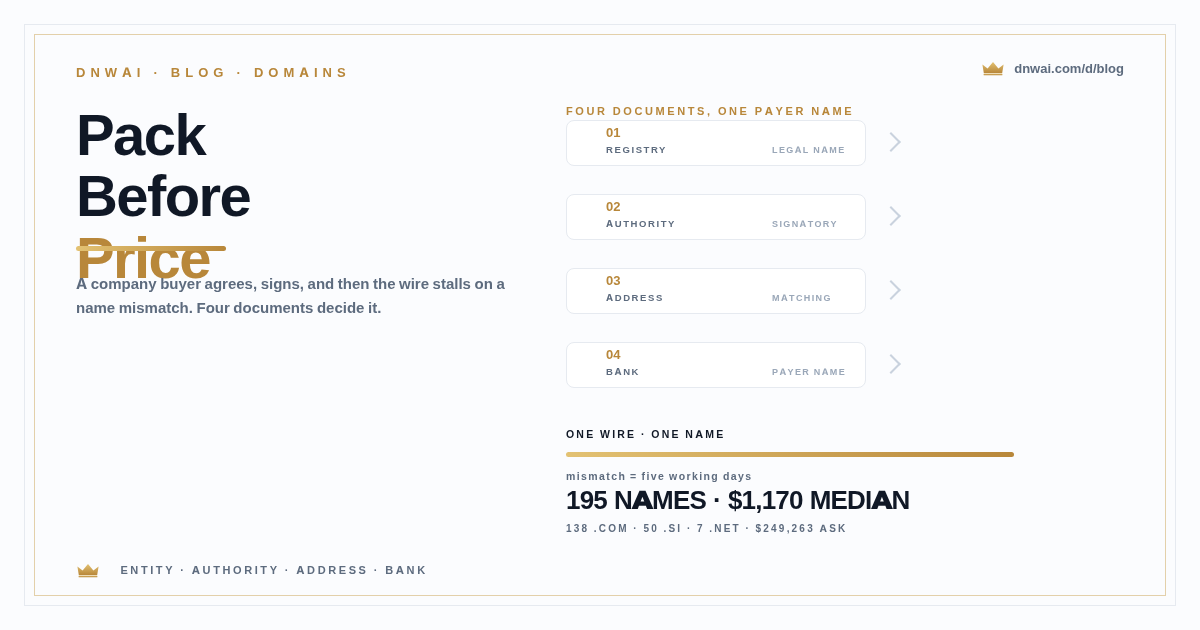
The check resolves into four items, usually requested together:
- Proof of the entity. A registration extract, articles, or certificate of incorporation showing the legal name and the jurisdiction it was formed in.
- Proof of authority. Something showing the person who accepted the price can commit the company: a signatory list, a resolution, or a director listing consistent with the extract.
- Proof of address. A utility bill, bank letter or registry filing that ties the entity to a real address matching the extract.
- Proof of banking. A bank letter or statement header showing the account name that will send the wire, as an exact string.
The desk is not evaluating your credit or your intent. It is matching strings across four documents produced by four departments, and every mismatch costs a day of email.
The mismatch that stops the wire
The most expensive mismatch is also the most ordinary: a subsidiary pays for a name that the group trademarks, or a parent pays for a name a subsidiary will trade on.
A marketing lead at a group with three operating companies picks a name for a new product line. The product takes the name of the subsidiary. The purchase order is raised by group treasury. The wire leaves the parent's account. The domain, once transferred, should be registered to the subsidiary because the subsidiary will trade on it.
Three entities, three departments, all correct — and a verification desk holding a bank statement in the parent's name wanting a registry extract in the subsidiary's name. What unblocks it is one short document: an intercompany authorisation, or a one-paragraph letter on group letterhead confirming the payer and the registrant are related and consenting to the arrangement. Finance can produce it in ten minutes if asked before the offer is accepted, and in two weeks if asked after the escrow is funded.
The same pattern in smaller shapes:
- A buyer whose company was renamed last year has a bank statement in the old name and an extract in the new one.
- A buyer trading as one brand while registered under a holding company that owns only trademarks.
- A buyer in a jurisdiction whose registry extract and bank letter are not in English.
None is a red flag about the buyer. All three cost the same five working days in the wrong order.
When to raise it — and how
In every deal this conversation is cheap or expensive depending on timing. Cheap: after the buyer shows genuine interest and before you accept a number. Expensive: after acceptance, when the buyer has committed internally to a launch date and every extra day carries political cost for whoever championed the purchase.
The framing that works puts the requirement in the process rather than in your suspicion: "Happy to proceed at the agreed figure. The escrow will ask for the registrant details and a matching payer name, so if the invoice should be addressed to a specific entity, tell me its legal name now and I will put it on the agreement — that way the transfer and the wire clear in one pass."
That line names the requirement, offers the buyer the chance to specify the entity, and frames the request as shortening their own path to the domain. Company buyers respond well, because they already know the internal paperwork is annoying and would rather do it once.
What not to do:
- Do not ask for bank statements or account numbers. You are testing that the payer name and the registrant name can be reconciled, not that the buyer is solvent.
- Do not accept a promise to sort it out at escrow. The sorting out is the delay.
The pack, assembled before the price
The practical move is to hold a template pack for both sides of every deal, so a company buyer fills in blanks rather than starting a process. On our side: four items.
- Registrant letter. A plain statement of who currently is the registrant of the name, in which jurisdiction the entity sits, and that the seller has authority to transfer it. One page, signed.
- Seller authority. If the portfolio sits in a company rather than a personal name, the intercompany notice written from our end: payer, holder and consent.
- Auth-code workflow. Which mailboxes receive the transfer code and who is available when it lands. A code in an unmonitored inbox is indistinguishable from a code that never arrived.
- Post-transfer registrant details. The exact string the buyer wants in the registrant field, agreed in writing before the transfer starts.
For the buyer, the same four items mirrored. The reason to build a template rather than improvise is that the questions do not change — only the document formats do, and only by jurisdiction.
What this looks like on a real shelf
Our 195 names carry a range that matters here: a $120 .net at the floor of the shelf and a $5,300 .si at the ceiling, with $82,000 of the total ask sitting in the $1,000–$1,999 band alone. A company buyer who has budgeted for a $4,999 .si has an approval chain behind the number, and each hop produces another document with another name format on it.
A $199 name sold to an individual is one identity: a $4,999 name sold to a company is four documents, two jurisdictions and an internal launch deadline. The price band predicts the paperwork burden better than the name does.
It also explains a pattern that looks like disinterest. A company buyer who goes quiet for a week after accepting a price is usually not reconsidering; they are inside the third round of a document exchange nobody warned them about. One email offering the entity line early turns that week into a day.
A stalled transfer is never quiet
A domain transfer that fails verification does not fail loudly. It stalls: the auth code expires, the transfer window closes, the name stays where it is, and the buyer's launch slips. The stakes scale with the name: a stalled $199 transfer is an inconvenience; a stalled $4,999 transfer to a company that has already printed the brand on packaging is a reputation problem for the seller.
We hold a fixed portfolio of these names and expect to be selling into the same markets for years. The cost of one stalled company sale is not the sale — it is that the buyer's finance team remembers the seller who required three rounds of documents.
Four checks we run before requesting the wire
Before any buyer with a company payer name reaches the funding step, we run four short checks. They take an afternoon and have removed most of the surprises from our own transfers.
- Entity line confirmed in writing. Legal name, jurisdiction and the exact registrant string the buyer wants, in the thread, before the price is agreed.
- Payer-to-registrant relationship stated. If they are not the same entity, one line explaining the relationship and consenting to it.
- One format agreed. Which registry extract, which bank letter format, which language — fixed once, so the desk does not ask for a fourth version.
- Transfer window scheduled. Two business days when both sides have someone who can read a code and click a link. Escrow deadlines are shorter than launch deadlines, and the transfer does not wait for a holiday.
None of these are contractual. They are the equivalent of checking the printer has paper before the meeting: trivial early, structural late.
The paperwork is the product
It is tempting to treat all of this as overhead around the real work of selling names. It is not. A seller who can hand over a clean pack is a seller a buyer can buy from twice. For a seller holding 195 names, a five-day close against a fifteen-day close is not one deal — it is whether a dozen future deals start warm or cold.
Prices on our shelf will move; the median has moved before and will again. Assemble the pack before the price, name the entity line in the first real conversation, and the last week of the sale gets short.
Buying a name this week?
193 exact-match, brandable and geo domains — buy-now price, escrow-protected, same-day transfer. See the portfolio · the contact page