
BIN vs Make Offer: Which Converts Better for Brandables
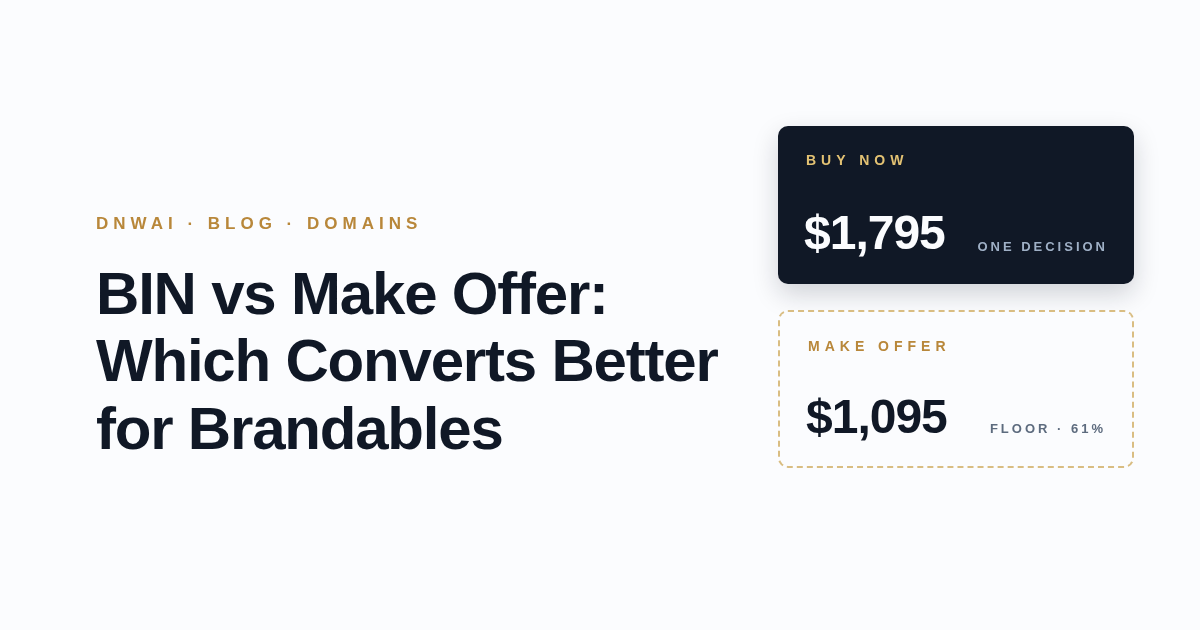
Every name on our shelf carries a buy-now price, and the pricing sheet we built on 10 October put the make-offer floor at a median 61% of that price. Which setting converts a brandable, what a public floor does to the first number, and the three listing settings we run.
A brandable is the hardest thing to price on any shelf, because there is no comparable sale to argue with. A dictionary word in a country-code extension has comps. A geo name has rents. A coined name like Alwam or Solarell has nothing but the number the seller typed and the number the buyer is willing to say out loud. That is why the buy-now versus make-offer question is not really a marketplace setting. It is a question about who says the first number.
We have run both on the same shelf, and we have paid for the lesson in the least pleasant currency: names that sat at a fixed price for a year while an offer button would have produced a conversation, and names where the offer button produced a $50 bid against a $295 ask and nothing else.
What the two settings actually ask the buyer to do
A buy-now price asks for one decision: is this name worth this amount to me today? The buyer compares your number against their budget and against the other names they looked at this afternoon, and answers yes or no. The seller keeps all the information and none of the conversation.
Make Offer asks a different question, and it is a much harder one: name a price for something you have never bought, in a market you do not follow, from a seller you have never met. Almost nobody does that well. When a buyer cannot price something, the safest number they can invent is a low one — low enough that they will not feel foolish if the seller says yes immediately. That first number then anchors everything that follows, including your counter.
So the two settings are not competing on conversion rate in the abstract. They compete on who carries the pricing risk. A buy-now price moves the risk to the buyer. Make Offer moves it back to you, and the price of that move is the anchor.
The floor ratio from our own pricing sheet
On 10 October we built a pricing sheet for thirteen names we were preparing to move to a premium marketplace. For each one we recorded the current buy-now price, the marketplace AI appraisal, a recommended buy-now price, and an offer floor — the lowest number we would accept without feeling robbed.
The shape of that sheet is the argument:
- Current buy-now prices: median $375, total $5,498 across the thirteen names.
- Marketplace AI appraisals: median $1,999, total $24,587.
- Recommended buy-now prices: median $1,795, total $21,635.
- Offer floors: median $1,095, total $13,335 — which is 61.6% of the recommended total, and between 55% and 65% on every individual line.
Two things are worth pulling out of that.
First, the recommendation was to raise prices, by a median of 4.8 times against what we had been asking on those names. Not because the names changed, but because the channel changed: a marketplace where buyers search by keyword is a different market from a parked lander with no traffic. A buy-now price that is too low is not a bargain, it is a signal that the seller does not know what they have.
Second, the floor never dropped below 55% of the recommended price. That is deliberate. A floor at 61% is not a discount — it is the price at which the deal stops being worth doing. The moment a floor falls to a third of the buy-now price, the buy-now price stops being a price and becomes decoration, because every buyer who can see both numbers negotiates from the lower one.
One line on that sheet ran the other way. ParalegalLab.com was listed at $2,195 against a model that recommended $1,295. That is the more common error on a hand-priced shelf.
The $295 name that received a $50 offer
We have written this thread up before; it is the cleanest evidence we have.
A name was listed at $295. A buyer opened with $50, which is 17% of the ask. We countered at $199, which is 68% of the ask, with a 72-hour deadline. The buyer did not move, and the thread closed.
Read it as a listing decision rather than a negotiation story:
- Under buy-now only, there would have been no thread at all. The buyer either pays $295 or leaves, and we would have learned nothing.
- Under Make Offer with a floor at 61% of $295, about $180, the $50 would have been declined automatically, and we would have learned the same thing we learned by hand: this buyer's ceiling sat under $200.
- Under a buy-now price of $199, nobody would have offered $50 in the first place, because there would have been nothing to negotiate.
The $50 offer was not a failure of the offer button. It was the offer button doing its job: it produced information in a day that a fixed price would never have produced. The failure would have been accepting it.
Where a fixed price wins outright
Fixed prices win on the part of the shelf where the decision is small.
Of the 177 priced names on dnwai.com/d/, 133 — 75% — carry an ask under $500, and 36 of those sit under $200. The median ask across the shelf is $488, the mean is $689, and the whole priced shelf adds up to $121,872.
On a $150 or $195 name, a Make Offer button is close to a mistake. That buyer is not hiring a naming consultant; they are deciding whether to spend the price of a dinner on a better domain than the free one they were about to use. The decision takes a minute. An offer button turns one minute into a negotiation over $40, and at that size the seller's attention is the scarce resource, not the $40.
A public price also does the filtering that email cannot. When the number is on the page, the "what is your best price" message never arrives, because the answer is already written. Across a shelf this size that is worth more than the occasional extra point of margin.
Where offers win, and why it is a different shelf
Offers win where the number genuinely cannot be known.
A coined brandable with no comparable, a name whose only real buyer is one specific company, a name in an extension where the last recorded sale was two years ago — on those, a public buy-now price caps you at your own guess. If the right buyer would have paid $3,000 and you published $795, the publication is the mistake, not the buyer.
There is a second, less obvious advantage: an offer button manufactures threads. Our cold outreach numbers this year are 100 candidates, 57 with no newsletter to unsubscribe from, 23 replies and exactly 2 human replies. A human thread is the scarcest asset in this business. An offer form produces them without a single email sent, and each thread arrives carrying the buyer's own number, which is better information than any appraisal.
The three settings we run now
- Fixed buy-now price only, under roughly $500. No offer button, no floor, no negotiation. The price is the price and the escrow link does the rest.
- Buy-now price plus a floor, between $500 and $2,000. The floor sits at 60–65% of the price. Below that the buy-now price is fiction; above it the button does nothing.
- No public price at all on names with a named buyer or a live appraisal far above the ask. Those go to outbound and to a private floor, because publishing a number is a one-way door.
There is a fourth setting, common in the market, that we do not use: Make Offer with no floor. That is a data-collection exercise rather than a sales channel, and it is fine only if you enjoy reading $50 offers.
Four mistakes that cost real money
Floor set too low. A floor at 30% of the price publishes a 70% discount and turns the listed price into decoration. The buyer negotiates from the floor, because the floor is the only number the seller has actually tested.
Raising the price to make the offer look generous. Buyers who arrive through an offer form are not comparing your new price against your old one. They compare the listed price against the floor, and widening that gap only tells them where the real number is.
Different numbers on different venues. A $1,795 price on one marketplace and a $995 floor on another is not two channels; it is one published price range. Marketplaces index each other more reliably than sellers expect.
Make Offer on a name under $200. The negotiation costs more attention than the name costs money. On a two-hundred-dollar name the correct button is the buy button.
The test we apply before choosing
Five questions, in this order:
- Does a comparable sale exist in this extension within the last two years? If yes, publish a fixed price and skip the offer button.
- Is the buyer a company already trading under a near-match? If yes, no public price — go to outbound with a private floor.
- Is the price under $500? If yes, fixed price only.
- What is the floor as a share of the listed price? If it is under 0.6, the floor is the price and the listed price is a rumour.
- Can you defend the floor to the buyer in one sentence, without embarrassment? If not, it is too low.
None of those answers requires a forecast. They require knowing which names on your shelf have a market and which ones have only an opinion.
Sources and method
The portfolio figures are read from dnwai.com/d/ on 21 October 2026: 177 priced names — 146 .com, 23 .si and 8 .net — with a median ask of $488, a mean of $689 and a total of $121,872. The pricing sheet is our own atom-pricing-proposal.csv dated 10 October 2026, thirteen names, with the floor column sitting between 55% and 65% of the recommended price. The $50 offer is a real inbound enquiry from this year against a $295 ask, countered at $199 with a 72-hour deadline. Commission rates quoted elsewhere on this blog are the published rates we are charged. No conversion percentages are estimated in this piece; where we do not have the number, we say what we observed instead.
Buying a name this week?
154 exact-match, brandable and geo domains — buy-now price, escrow-protected, same-day transfer. See the portfolio · the contact page