
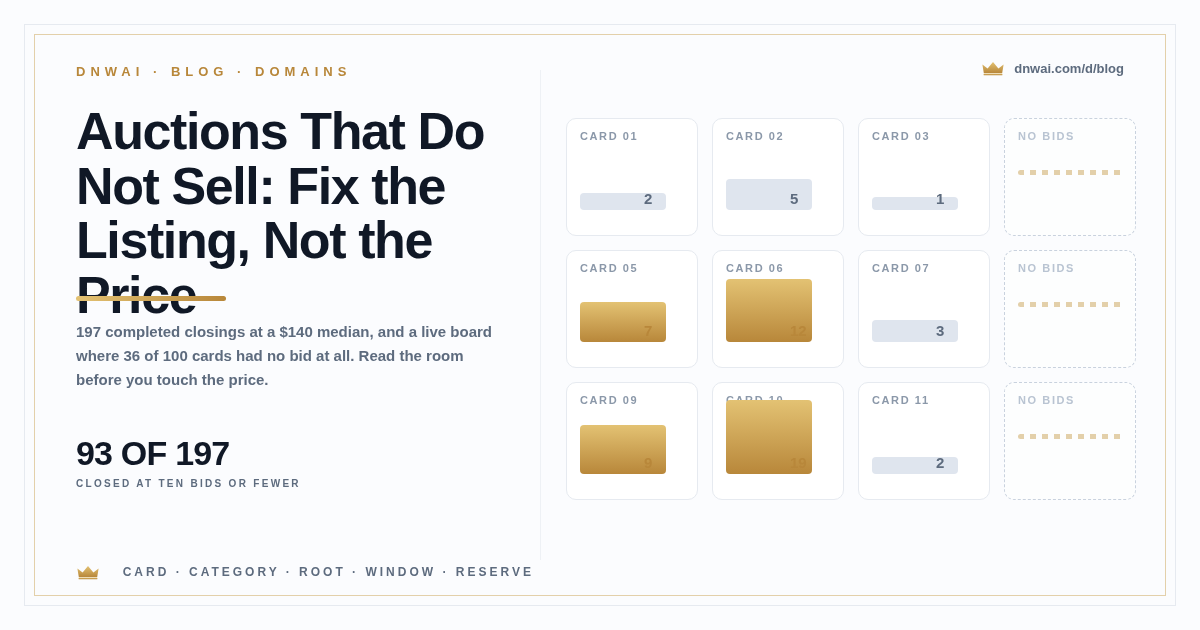
Auctions That Do Not Sell: Fix the Listing, Not the Price
An auction that does not sell leaves no error message. The event closes, the name goes back to your shelf, and the only signal you get is silence. The instinct is to reach for the price. Before you do, read what the room actually did with the card — because in almost every stalled auction the room left a diagnostic behind, and it is usually free to fix.
Two data sets make this concrete. The first is the wall of completed auctions: the recently closed .si results on Atom, 302 cards that deduplicate to 197 distinct closing prices, with a median close of $140 and a reserve-met median of $350 against a no-reserve median of $120. The second is the live auction board, pulled on a single day: 100 cards on the first page of 4,903 active lots. Both are pages you can read yourself in a browser. What follows is how to read them against your own listing.
The live board reads more honestly than any forum thread
On the day I pulled it, the active board's first page held 100 cards. Thirty-six of them had zero bids. Eighty-nine had five bids or fewer. Not one had reached forty. The median bid price across cards that had a bid at all was $50, against a median asking price on those same cards of $4,999 — a bid-to-ask ratio with a median of about 1%.
That last number is the one people misread. It looks like buyers are insulting sellers. It is not an insult, it is a measurement of how the board is used. Very few people bid early in a public auction with days left on the clock. Bidding early only tells the room you want the name. The room bids in the last hours, often in the last minutes, because that is when the information is complete: who else is in, how high they went, and whether the reserve is reachable.
Which means a card with two bids and three days left is not a failed card. It is a card that has not been tested yet. A card with zero bids and one hour left is a different animal entirely.
Bids are not demand — bidder counts and timing are
Three fields on the card tell you more than the bid count: the number of distinct bidders, the number of recent bids, and how much time is left. A card with nineteen bids from six bidders is a card where six people kept going back to the same number. A card with nineteen bids from nineteen bidders is a different story. On the board I read, the median bidders per card was two, and many cards showed recent-bid counts equal to their total — an auction that has been sitting untouched, not one that is warming up.
The completed wall makes the same point with closing prices. In that set, 93 cards closed with ten bids or fewer at a median of $110; five cards drew forty bids or more and closed at a median above $2,000. A forty-bid card was not a lucky card. It was a card that reached people who wanted the name.
So when your auction closes without a sale, the first question is not "was my price too high". It is "did my card ever get into a room where bidding was possible".
The five failure modes, in the order they appear
Read a stalled auction against these five checks in order. The first two are the most common and the cheapest to fix.
One: the card does not survive a thumbnail
The auction board is a grid of small images. Before anyone reads the name, they see the visual. In the live page I pulled, 82 of 100 cards carried a designed logo mark and 18 did not. A placeholder image in a grid of designed marks is the visual equivalent of an unopened shop. It is also the cheapest failure to repair: a proper card with the name as the dominant element, tested at thumbnail size, costs an hour.
There is a second card failure that does not show up in a screenshot: a name that cannot be parsed at a glance. Long compound names, three-word strings and names with a digit tucked in the middle all lose the two seconds the grid gives them. If a stranger cannot say the name out loud after seeing the card once, the card has failed regardless of art quality.
Two: the category sends the card to the wrong room
Each listing carries categories, and those categories decide which buyer searches ever see the card. On the live page, 48 of 100 cards were tagged Tech/Internet/Software, 32 E-Commerce & Retail, 26 Health & Wellness, 23 Education & Training — and 15 cards carried no categories at all. A card with no categories is only visible to someone scrolling the unfiltered board, which is a very small room.
The fix is not to add every category your name could plausibly fit. It is to pick the narrowest one where a real business owner would search. A payments-flavoured name belongs in Finance, not in Tech plus Finance plus Crypto; adding categories dilutes the match rather than widening reach.
Three: the root word is not the root word buyers use
Marketplaces index listings by root word, and the index does not always agree with the seller. A name built on an invented root — a real word with a letter bent, a two-word blend that only the seller can decompose — indexes as nothing, and nothing is what it surfaces for.
This is where the extension count earns its keep as a diagnostic. In the live page, cards whose name was registered in fifty or more TLDs had a median bid price of $250; cards in fewer than twenty TLDs had a median of $50. That is not because the rarer name is better. It is because a name registered across many extensions is a name that other people, in other markets, already recognised as worth holding. The TLD spread is a proxy for recognisability, and recognisability is what makes a root indexable.
Four: the event window was wrong, not too small
Sellers assume a bigger auction is a better auction. The completed wall suggests the opposite. Bidding density — how many qualified bidders are looking at cards like yours during the window — matters more than total audience. A quiet event with a focused category can produce more bids on your card than a headline event where your listing is one of hundreds competing for the same attention.
Timing inside the window matters too. On the live board, cards clustered by end date: 42 closing on one day, 17 the next, 13 the day after, 12 the day before. Reading which day is crowded is worth doing before you pick a slot, because the crowded day is the day your card gets the least attention per bidder.
Five: the reserve is above the band the market is actually paying
Only now do you touch the reserve. On the completed wall, reserve-met sales closed at a median of $350 while no-reserve sales closed at $120. That gap is not evidence that reserves create value. It is a selection effect: a reserve-met sale means at least two bidders wanted the name past the seller's floor, so the record only exists for names with real demand. No-reserve listings always produce a record, at whatever the room would pay.
The practical reading: if your name has already passed a clean card, a correct category, a legible root and a sensible window, and it still did not reach the reserve, the reserve is the wrong number. Set it at the reserve-met median for its band and let the room price the name.
The AI number is not the reserve, and the ask is not the AI number
On the live board, the median ratio of asking price to the platform's AI valuation was 0.746 — sellers were asking roughly three-quarters of the AI number. That is a healthier starting point than it sounds, because it means most sellers are already discounting the appraisal.
But look at what separates the cards that attracted bids from the ones that did not. The 36 cards with zero bids carried a median ask of $5,499 against a median AI valuation of $9,643 — a ratio near 0.57, more discounted than the board average. The eleven cards with six or more bids carried a median ask of $4,999 against a median AI of $4,099 — asking above the AI number.
That result will annoy anyone who assumed cheaper listings win. The cheap-and-unbid cards were not cheap because they were bargains; they were cheap relative to an AI number that had landed on a fantasy figure for a name nobody recognised. The bidded cards were asking above their AI number and still drawing bids, because the name itself was legible to buyers.
The lesson: an AI valuation is a starting point for a conversation, never a reserve. A big gap between your ask and the AI number does not mean you are overpriced — it often means the appraisal is disconnected from the market. A small gap does not mean you are priced right. Read the bid behaviour, not the ratio.
What to change, in order, after a failed auction
Five steps, four of them free:
- Card first. Regenerate the visual with the name dominant at thumbnail size.
- Category second. Re-list against the narrowest category a real buyer searches.
- Root third. Check how the name indexes, and whether the extension count suggests anyone else values it.
- Window fourth. Move to a less crowded closing day rather than a larger event.
- Reserve fifth. Reset to the reserve-met median for the band. Price changes come last, always.
If your auction closed with few bids, the room was empty for your card. Fix the card, the category, the root and the timing — then decide whether the price was ever the problem.
The numbers to carry into the next event
From the completed wall: 197 distinct closings, a median of $140, a reserve-met median of $350 against a no-reserve median of $120, and a bid split of 93 cards at ten bids or fewer against five at forty or more.
From the live board on the day I read it: 36 of 100 cards with zero bids, 89 at five bids or fewer, a median bid-to-ask ratio near 1%, 15 cards with no category, and a $250 median bid price for cards registered across fifty or more extensions against $50 for cards in fewer than twenty.
Both sets are public. Neither requires a subscription, a tool, or an opinion. Twenty minutes on a completed-results page and a live board will tell you more about your own stalled listing than any forum thread about "the market being slow".
A name that does not sell at auction is not necessarily a bad name. More often it is a good name in a card built for a different room — and the room can be changed.
Buying a name this week?
192 exact-match, brandable and geo domains — buy-now price, escrow-protected, same-day transfer. See the portfolio · the contact page